
The Continuing Decline Of India’s Social Sector Budget
Under a fifth of the Union budget is allocated to the social sector, and infra-heavy schemes such as affordable housing and rural roads are leaving money unspent
New Delhi: India’s social sector budget as a share of the gross domestic product is now second lowest in over a decade, and lower even than 2014-15, when the Narendra Modi government presented its first-ever budget.
While Budget 2026-27—presented on February 1—shows small increases for welfare schemes, utilisation remains low: In 2024-25, the latest year for which actual spending data are available, eight key ministries saw between 0.3% and 78% of the budgets unspent. Infrastructure-heavy schemes, such as the rural and urban housing, rural roads and the household tap water programmes were no better. Revised estimates for the current financial year follow similar trends.
India’s efforts to reduce its fiscal deficit—the difference between what it earns and what it spends—have constrained its capacity to invest in the social sector, our analysis of budget documents shows.
For 2026-27, finance minister Nirmala Sitharaman allocated 18% of expenditure to the social sector. Taken as a share of the gross domestic product (GDP), the sector received 2.5%, lower even than 2014-15, when the Narendra Modi-led government presented its first ever budget. Even prior to the pandemic, as IndiaSpend reported in February 2025, the share of social sector spending did not see an increase.
To put this into perspective, for health alone, the National Health Policy (NHP), 2017 set a target of increasing total public health expenditure (including that of states) to 2.5% of GDP by 2025. Spending, however, remains lower at 1.7% of GDP 2024-25 REs, as per the Economic Survey 2025.
Budget speeches have consistently emphasised infrastructure-led growth as a central pillar of development. Yet, many large infrastructure schemes continue to face low utilisation, repeated deadline extensions, and persistent implementation gaps at the state level, our analysis shows.
Meanwhile, non-infrastructure social sector programmes have seen limited redesign or innovation, with allocations in several areas even declining in real terms, as needs continue to grow.
The emphasis, as we said, is now on reducing the fiscal deficit, while prioritising capital expenditure as a driver of medium-term growth. In practice, this has largely been achieved by restraining revenue expenditure—the portion of the budget that funds salaries, pensions, subsidies, and a majority of the social sector schemes. With interest payments accounting for nearly one-fourth of total Union government expenditure and around 40% of revenue receipts for 2026-27, the fiscal space for discretionary spending has narrowed.
“The entire burden of fiscal consolidation at the time of decreasing tax revenue is being borne by the social sector,” says Dipa Sinha, development economist and associate professor at Azim Premji University.
On paper, allocations across several welfare sectors continue to show small increases year-on-year. But when read over time—and especially against actual spending—another trend becomes visible.
Poor utilisation on infra-heavy schemes
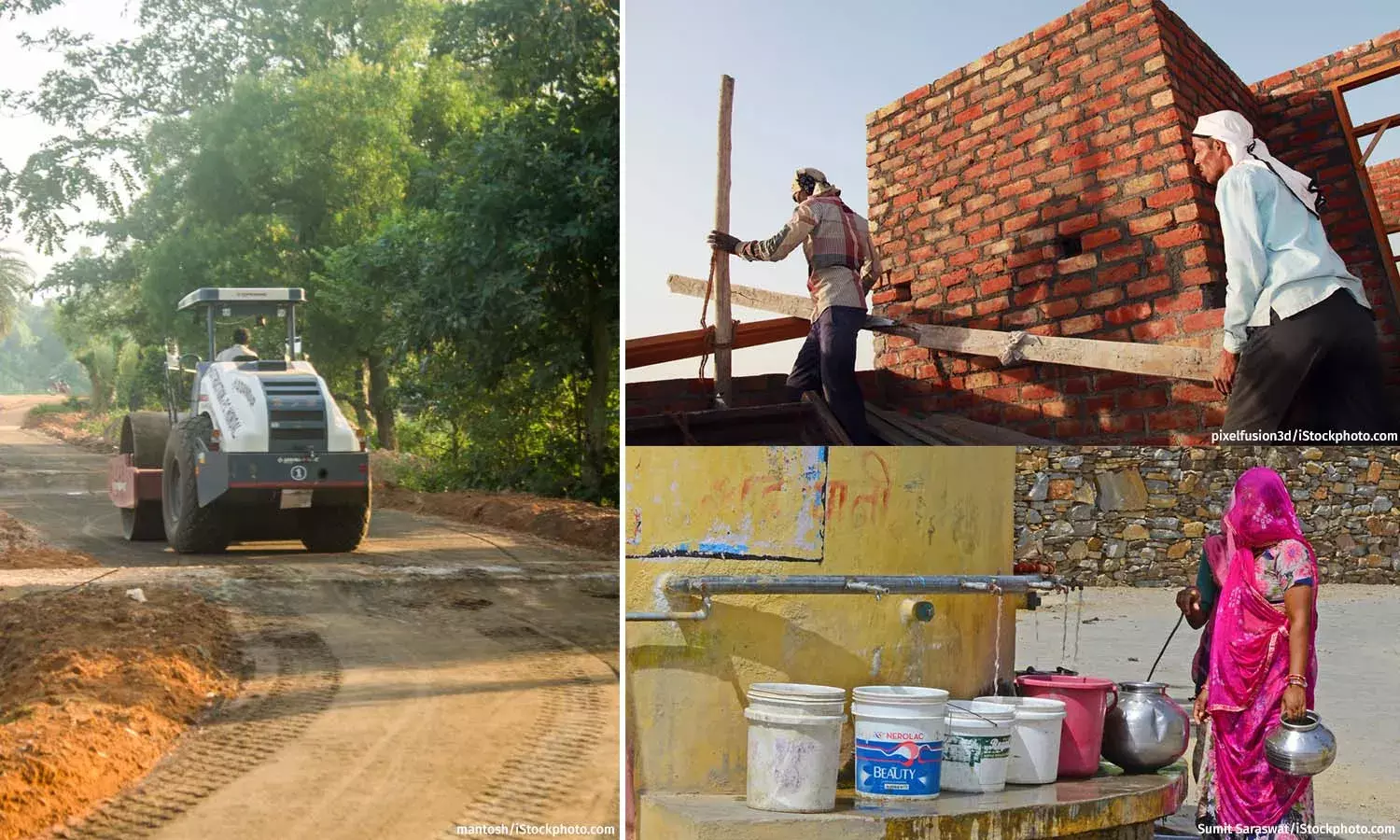
Overall, 38% of social sector spending flows towards infrastructure-linked programmes. These include the Jal Jeevan Mission, launched in 2019 to provide functional household tap water connections to all rural households; the Pradhan Mantri Awas Yojana–Gramin (PMAY-G), which supports construction of pucca houses for rural households; the Pradhan Mantri Awas Yojana–Urban (PMAY-U) and its recent 2.0 version, aimed at expanding affordable housing in urban areas; and the Pradhan Mantri Gram Sadak Yojana (PMGSY), which finances rural road connectivity. Education (14%) and health (11%) see lower shares.
Here, the figure for infrastructure includes spending under the ministries of housing and urban affairs, Jal Shakti and rural development, while that for health includes AYUSH and health ministries.
In 2024-25, these schemes utilised less than two-thirds of their budgets, except for the rural roads programme. This is similar to the year before, when except for JJM, every scheme saw underutilisation ranging from 20-60%.
For the next financial year, the government has allocated similar or slightly increased amounts as the current year—a pattern consistent with earlier trends.
This leaves programmes with unspent money: For instance, for rural housing, lower utilisation in recent years has resulted in high opening balances. In 2025-26, states reported an opening balance of Rs 21,076 crore.
Urban housing shows a similar pattern. With releases and completion of houses slowing down, the Union government has announced that no further Union government assistance will be available after December 2025 under PMAY-U, and the cost of completion will need to be borne by the states.
For JJM, in 2025-26, no Union government releases were reported till January 2026, and actual spending may thus be lower.
Welfare ministries underspent by up to 78%
In 2024-25, the latest year for which actual spending data are available, social sector spending fell to an all-time low in a decade of 17% of total expenditure, with only Rs 7.7 lakh crore spent.
“Within social sector ministries, it is those focussed on the marginalised such as minority affairs, social justice, development of north-east and so on that see the most cuts,” Sinha says.
The minority affairs ministry, which administers programmes such as Pradhan Mantri Jan Vikas Karyakaram (PMJVK) aimed at providing basic amenities and socio-economic assets in minority concentrated areas, the PM-Viraasat Ka Samvardhan (PM VIKAS) which focuses on skilling, entrepreneurship and leadership training requirements of the minority and artisan communities in addition to scholarship schemes, saw a 78% drop between budget and actual spending.
The ministry of labour and employment, which funds social security schemes for workers such as pensions for industrial workers, unorganised workers under Pradhan Mantri Shram Yogi Maandhan, and also for shopkeepers/retail traders and self-employed person under Pradhan Mantri Karam Yogi Maandhan, spent just over half of its budget. Even health (0.3%) and women and child development (5%) ministries saw cuts.
Underspending in the health sector points to structural limits rather than funding gaps, Nachiket Mor, visiting scientist at the Banyan Academy of Leadership in Mental Health, told IndiaSpend this week. “There is more investment, but increasing money is not the answer. The problem is how the health system is designed and run,” he explains.
A similar pattern can be seen in 2025-26, indicating mid-year downward revisions in allocations.
For education, even as Budget 2026-27 increased allocations for Samagra Shiksha, the Union government's flagship programme for school education scheme, budget cuts have resulted in a reduction in approved budgets of states in recent years. Approved budgets in 2025-26 were 8% (or Rs 5,719 crore) lower than those of the previous year.
Similarly, while the Budget Speech emphasised empowering Divyangjan or the people with special needs through livelihood opportunities, skilling, and the provision of assistive devices, allocations for historically marginalised groups such as minorities, women, and persons with disabilities remain low.
Between 2019-20 and 2024-25, funding for these groups together accounted for less than 5% of the total social sector expenditure. In 2026-27, allocations are projected to rise to around 6%.
Key schemes aimed at women and child protection, such as Mission Shakti and Mission Vatsalya, witnessed reductions at the RE stages in 2025-26 of 37% and 27%, respectively.
Centrally Sponsored Schemes (CSS)—programmes where the Union government provides funding but states implement them—have long served as the Union government’s primary vehicle for delivering social sector programmes, but this architecture has repeatedly drawn scrutiny.
Successive Finance Commissions, including the XVI Finance Commission in its recent recommendations, have reiterated the need to rationalise and restructure CSS to reduce fragmentation, improve flexibility, and align spending responsibilities more clearly with states’ implementation roles.
IndiaSpend reached out to the finance ministry and NITI Aayog, the government’s policy think-tank, for comment. We will update this story when we receive a response.
Pritika Malhotra contributed to this report.
We welcome feedback. Please write to respond@indiaspend.org. We reserve the right to edit responses for language and grammar.