
Health Budget Grows Every Year. So Why Isn't Public Healthcare Improving?
The Union health budget is up 9% since the current year. Yet many Indians continue to avoid public healthcare facilities
Mumbai: Finance Minister Nirmala Sitharaman today announced a Rs 1.06 lakh crore health budget for 2026-27, a 9% increase from the current financial year. Yet persistent gaps in utilisation, staffing and quality suggest higher allocations alone cannot fix India's public health crisis.
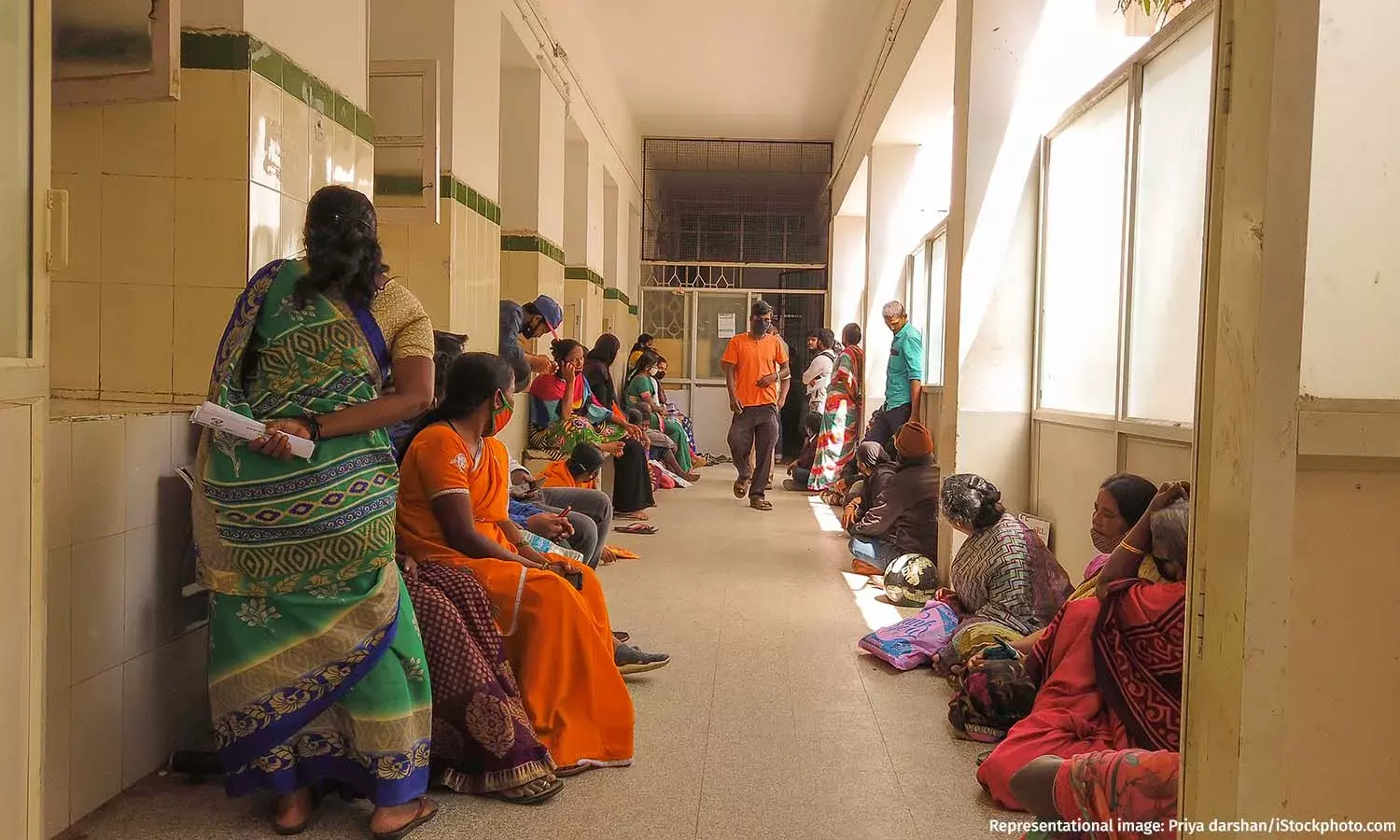
Despite a decade of expanded budgets and infrastructure—183,833 health centres upgraded, 157 new medical colleges approved—about 50% Indians avoid the public health sector citing poor quality, long waits, and staff shortages.
The largest component is the National Health Mission (NHM), which received Rs 39,390 crore in 2026-27, up 6.1% from the expected spending this year.
Yet, fund utilisation under NHM remains persistently weak. In 2022-23, only 65% of allocated NHM funds were spent, declining further to 62% in 2024-25, as per a January 2026 analysis by the Foundation for Responsive Governance (ResGov), a New Delhi-based non-profit aiming to strengthen government and community capabilities. In Uttar Pradesh and Punjab, less than half of NHM funds were utilised.
“The government is continuing to fund the public sector. There has been a large expansion of health and wellness centres over the past few years,” says Nachiket Mor, visiting scientist at the Banyan Academy of Leadership in Mental Health.
By February 1, 2026, 183,833 primary health centres, sub-centres and urban health centres have been upgraded to Ayushman Bharat Health and Wellness Centres (now called Ayushman Aarogya Mandirs), each meant to serve populations of 3,000 to 5,000, as per the data from Ministry of Health and Family Welfare.
For health and wellness centres, only 40% of allocated funds were spent in 2024-25, another analysis by the nonprofit found.
Mor argues that this points to structural limits rather than funding gaps. “There is more investment, but increasing money is not the answer. The problem is how the health system is designed and run,” he explains.
“The issue is not how much you announce,” says Amulya Nidhi, National Convener of Jan Swasthya Abhiyan India. “It is whether the money reaches the health centre and the patient.”
“Governments are already spending enough money,” Mor adds. “The problem is whether the public system is organised to deliver outcomes.”
Investment has also expanded in medical education. Since 2014, 157 new medical colleges have been approved, of which 108 are functional, the government told the Lok Sabha in February 2024. In today’s budget, the government allocated Rs 1,877 crore for human resources for health and medical education in 2026-27, including in research.
In her budget speech today, finance minister Nirmala Sitharaman announced that institutions for Allied Health Professionals (AHPs) will be upgraded and new AHP Institutions established in private and government sectors across 10 disciplines—with an aim to add 100,000 AHPs over the next 5 years.
In addition, she announced that the government will establish three new National Institutes of Pharmaceutical Education and Research, three All India Institutes of Ayurveda, and a National Institute of Mental Health and Neuro Sciences in north India.
Quality and capacity constraints
India’s public health infrastructure remains overstretched. India’s community health centres have an estimated 80% shortfall in specialists, meaning only about one in five surgeons, physicians, obstetricians/gynaecologists and paediatricians is actually in place.
Over time, some gaps have widened: Radiographer shortfalls at CHCs increased from about 35% in 2005 to 58% by 2022–23, government data show.
In effect, millions of Indians who need imaging studies or specialist care end up spending more money to reach district hospitals, increasing the burden at the tertiary care level.
In 2022, there were 7,908 people per government allopathic doctor—eight times higher than the World Health Organization recommendation, as per the analysis by ResGov. And in 2023, India had 1,666 people per government hospital bed.
There has been an enormous shortage of human resources in the public health care sector in the country, the health ministry acknowledged in its 2024-25 annual report, adding that NHM has attempted to fill the gaps.
On the other hand, while quality certification has expanded—with over 50,000 public facilities accredited under the National Quality Assurance Standards (NQAS) by December 2025—accreditation remains uneven across states and districts, the ResGov analysis further found.
Certified hospitals are more likely to meet minimum standards for infection control, diagnostics and patient safety, but most public facilities still operate outside these benchmarks, limiting trust and usage, as IndiaSpend reported in August 2023.
OOPE declines, but so has public healthcare usage
Out-of-pocket expenditure (OOPE) accounted for about 39% of India’s total health expenditure in 2021-22, down from about 63% in 2014-15. That is, for every Rs 100 spent on healthcare in India, Rs 60 is being spent by the government.
In absolute terms, household health spending increased from Rs 3.02 lakh crore in 2014-15 to Rs 3.56 lakh crore in 2021-22, but when adjusted for inflation, this correlates with the decline in the share.
“A fall in out-of-pocket expenditure is not always a good thing,” Mor says. “If people choose not to seek treatment at all, OOPE will fall. I have never seen this happen in a country except where there is widespread impoverishment.”
A comparison of per capita out-of-pocket spending illustrates Mor’s observation. In Bihar, average annual health spending per person is Rs 984, compared to Rs 7,889 in Kerala, as per the National Accounts report from 2021-22.
“Kerala’s out-of-pocket expenditure is higher than Bihar’s. That does not mean Kerala is worse,” Mor says. “It means people in Bihar are not seeking care at all.”
Lower spending in such contexts reflects avoidance of the system, not better protection. Nidhi says families remain vulnerable. “People are still forced to take loans or sell assets for treatment.”
About 80% of households in Bihar do not use government health facilities, compared to 50% nationally, according to a March 2025 analysis by PRS Legislative Research based on data from the National Family Health Survey 2019-21. The most cited reasons are poor quality of care (48%), long waiting times (46%) and lack of nearby facilities (40%).
Overall, health expenditure as a percentage of GDP rose from 1.3% in 2013 to 2.1% in 2022-23, we had reported in April 2024.
The National Health Policy, 2002, had set a target of 2% of GDP by 2010; the United Progressive Alliance government, in 2004, had set a goal to increase public-health spending to 2-3% of GDP over a five-year period; and the Centre’s 12th five-year plan set the target at 1.87% of GDP by March 2017, as IndiaSpend reported in July 2018. None of these goals were met, we had reported. The National Health Policy of 2017 increased this target to 2.5% by 2025.
The figure of 2.1%, for 2022-23, includes spending in water, sanitation and hygiene (WASH) and disaster management, Nidhi had told us.
States now drive outcomes
States account for 58% of government health expenditure, per the data from National Health Accounts. After the 14th and 15th Finance Commissions, a larger share of funds shifted to states as untied transfers.
Yet most states allocate less than the 8% of budgets recommended for health. In 2024-25, Telangana allocated 4.6%, Karnataka 4.8%, Tamil Nadu 5% and Bihar 5.7%, the PRS Legislative Research analysis shows.
“Earlier funds [from the Union government] were tied. Now they are untied. Some states choose to spend more on health, some do not,” Mor says.
Mor identifies Bihar, Jharkhand, Madhya Pradesh and Uttar Pradesh as states unlikely to reach universal health coverage without long-term fiscal transfers. “These states will need additional per capita transfers for several decades,” he says. “It cannot be that a child born in Bihar is entitled to less healthcare than a child born in Kerala.”
Until quality, staffing, accountability and system design improve, higher budgets are likely to coexist with low utilisation, weak trust, and persistent gaps in access.
Ahead of the budget presentation, IndiaSpend reached out to the health ministry for comment on health budget trends, out-of-pocket spending, and the utilisation of public health funds. We will update this story when we receive a response.
We welcome feedback. Please write to respond@indiaspend.org. We reserve the right to edit responses for language and grammar.