
Govt Claims It Is Blood-Sufficient. But Is It?
Vast parts of the country are characterised as “blood deserts” where blood is not available for transfusions
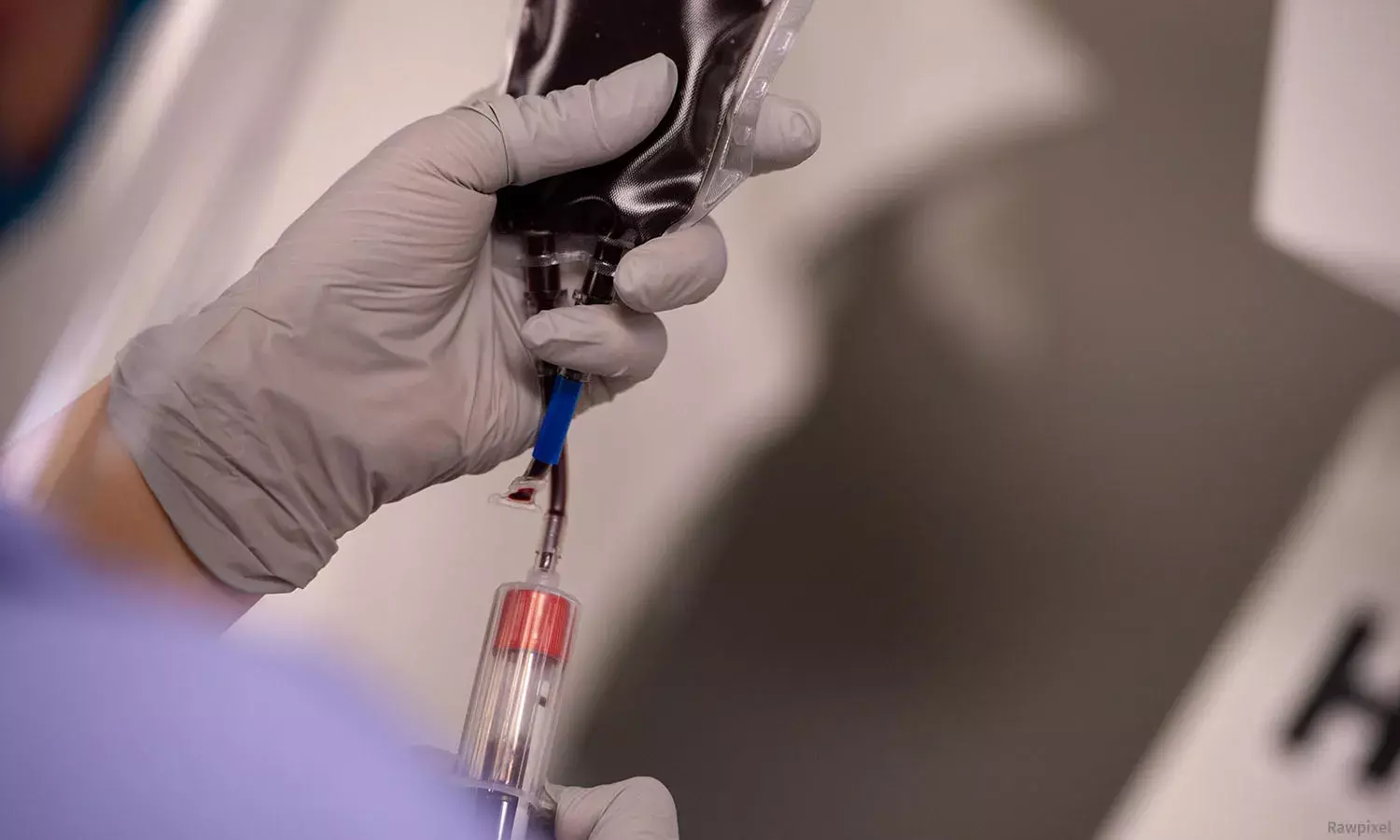
New Delhi: On August 19, 2025, the government claimed that the annual blood requirement for the county was met the previous year. This, despite several reports and studies on shortage of blood in various parts of the country and significant state, and intra-state variations in the availability of blood.
This is the second in a two-part series on blood availability in the country. In the first part, IndiaSpend looked at Jharkhand and how even as recently as November, people were going from hospital to hospital looking for blood units for their loved ones.
In a reply to a question by parliamentarian Ashok Chavan in the Rajya Sabha, the government said that the annual requirement of blood in the country is 14.6 million units, and a total of 14,601,147 units of blood were collected across the country in 2024-25, a 15% increase from 2023.
But this does not give the full picture.
The annual blood requirement figure of 14.6 million units possibly comes from a study commissioned by the National Blood Transfusion Council (NBTC) and published in 2018. The study used a projected population estimate of 1.31 billion in 2017, whereas the estimated population in 2025 is 1.46 billion. This means the demand is likely underestimated.
Besides, there are vast parts of the country which are characterised as “blood deserts”, as per a 2024 study. And the lack of blood influences the way in which clinical decisions are taken. For example, access to blood plays a significant role in providers’ decision to proceed with a common surgery such as a caesarean-section.
IndiaSpend reached out to the NBTC to clarify these concepts, and sent a detailed questionnaire to the Directorate General of Health Services (DGHS). We will update this story when we receive a response.
‘Blood desert’
In 2022, when this correspondent went to Giridih district hospital in Jharkhand, a 13-year-old girl was lying nearly unconscious in the hospital’s female ward, with relatives buzzing around her. She had severe anaemia, and had dangerously low haemoglobin levels—just 1 gram per decilitre (12 gm/dL is normal for women).
At the time, the Giridih Sadar hospital blood bank, which serves the entire district, had just one unit of blood—and not her blood group at that. Her relatives found a donor on their own, but that did not help stabilise her. Later, another relative donated one unit the next day.
Blood shortage in many parts of India is ubiquitous, say experts. In areas where there is such severe blood shortage, there is a risk of people dying of severe anaemia or haemorrhage, or other ailments related to trauma or emergencies related to childbirth, among others.
“Blood shortage is not a new story. The problem is that blood is maldistributed. There are blood famines because of maldistribution,” said Nobhojit Roy, chair of the Center for Leadership at the University for Global Health Equity in Kigali, Rwanda. Roy trained and worked in Mumbai, and underserved parts of the country.
The concept of a ‘blood desert’ describes this phenomenon. A ‘blood desert’ is a geographical area where it is impossible to meet the local demand for blood components timely and affordably in at least 75% of transfusion cases. It means that for people in this area, the blood facility is not nearby, or easy to reach, and/or lacks blood.
Roy is also one of the co-authors of the study on blood deserts and is part of the Blood DESERT Coalition, a group of doctors, researchers, patient advocates and policymakers who are working on eliminating world’s blood deserts.
Roy and his colleagues studied the inventory of blood products displayed on the government's E-Raktkosh platform in eight states. While the platform is supposed to collect live data, all blood banks do not necessarily update it.
e-Raktkosh: Centralized Blood Center Management System
The study states that essentially all these states that cover 46% of India’s population “represent an effective blood desert”. Researchers found significant regional variations in blood product inventory, with Madhya Pradesh having the highest stock and Uttarakhand and Odisha having much lower stocks. The study showed that the overall availability of blood in these states was “incredibly poor” at 0.68 units per 1,000 population at a 60-minute radius, with Bihar faring the worst at 0.17 units per 1,000 population at the same radius.
Deaths due to blood shortage
Roy said that doctors now have become risk-averse, because of fear of media glare and also state action. So if there is a shortage of blood, doctors at the district and sub-district level then choose to refer patients to higher levels. “There is more and more denial of care now. If the facility is not available, doctors say chod do (let’s not treat) and instead refer.”
This can sometimes lead to death. For instance, Bihar has a 3.6% C-section delivery rate in district hospitals, less than half the 10% recommended by the WHO. Only 26% of these hospitals had access to a blood bank or blood storage unit, a 2023 study published in Global Health Action showed.
One of solutions proffered by the Coalition is walking blood banks. “More than 30 years ago when I was working in Uttar Pradesh, even if there was a postpartum haemorrhage case, we would line up villagers and bleed them, cross match, test for infections and give blood. It would be magic seeing patients come alive. This despite the fact that the nearest blood bank is 300 km away,” said Roy. This is no longer legal (except in the Army), but continues to be a common strategy in India.
The other solution offered by this coalition is the use of drones to carry blood over long distances. “Rwanda is a land of thousand hills. If you have ever worked in a hilly area, you know it can take up to four hours to get anywhere. They have used drones and cracked the model,” said Roy. He added, “Bihar is as big as Ethiopia. There are so few functional blood banks to cover the entire state. In all these decades they have not managed to have functional blood banks. There is no electricity in many of them. Are we going to think differently?”
An official from Bihar State Aids Control Society, who did not want to be named, responded to the studies and said that all districts have a government blood bank, as well as private blood banks in the state. “I agree some blood groups may be out of stock. We ask for a replacement in that case. But, I do not think anyone has died because of lack of stock. We have not come across any such case in the media or heard of it,” he said. The state now has 129 blood banks, he explained, 50 of which are government-run.
The Indian Council of Medical Research (ICMR) did an extensive process of studying the use of drones in ferrying blood and blood products in the Delhi-National Capital Region area. It had studied the transportation of vaccines earlier, but transporting blood was more challenging.
“This was tricky because when the blood shakes too much or if the temperature rises, it can cause hemolysis (destruction of red blood corpuscles),” said Sumit Aggarwal, scientist with ICMR. “We designed the drone boxes in a way that the vibrations are limited, the temperature is maintained, and yet the blood does not touch the ice box directly.” The study was published in 2025, and operational guidelines to use drone technology to transport blood products have been issued.
Voluntary donation and blood sufficiency
None of these solutions can replace the need for blood sufficiency. For example, for a drone system to work, there needs to be enough blood in the blood banks.
Though the government claims that 70% of the blood collected in the country is voluntary, experts dispute this number, as we reported in part 1 of the series.
This is not just an ideal, according to them, but is something that can ensure that we are prepared for emergencies, rather than constantly reacting to an emergency.
“The question to ask is not if we have satisfied the requirement of blood in the country. The question is whether the blood collected is mostly voluntary or is a demand satisfied after the need arises and the patients’ family is sent running to find donors. Voluntary blood donation is relevant to the blood sufficiency in a given area,” said Vinay Shetty, chief executive officer at LifeBlood Council, a nonprofit dedicated to causes of voluntary blood donation and prevention, care and cure of thalassemia.
In 1981, Shetty did his first blood donation drive at BYL Nair Hospital, Mumbai when he was studying engineering. After he started his career too, he organised blood donation drives voluntarily. “I would get calls on my home landline number from people seeking blood donors with specific blood groups for their relatives or friends admitted in hospital,” said Shetty. “At the time, I thought doing a blood donation drive meant I got the contact numbers of as many donors as possible. That way I can help people who ask me for a donor of a specific blood group.”
In the 1990s, when he went to Breach Candy Hospital with his donor friends to help someone out, Shetty says he met someone in the hospital who asked him to do something about thalassemia children.
“It was at the time that my whole perspective changed. These children need blood transfusion once every three weeks. And here we are drawing up a list. It occurred to me that we have to ensure that enough blood is there in the blood banks,” said Shetty. He also met parents of children with thalassemia and later started working on voluntary blood donation and with thalassemia children full time.
He said blood donation is not about having a list of donors. “We need to have blood donation drives to fill the blood bank. I started going to colleges, National Service Scheme and later the corporate sector. Why should hospitals put pressure on patients? If they go to their college, housing colony, temple or church, they will donate,” said Shetty.
The blood collected from blood donation camps is less than half of the total blood collected in the country, government data show.
The National Blood Policy talks about phasing out replacement donations in a time-bound manner, but it adds that replacement donors can be encouraged to become regular voluntary blood donors, albeit without coercion. Blood donated voluntarily, especially by repeated donors, is safer, and has fewer infections.
“Everybody uses this loophole to add their family donors as voluntary donors,” said Shetty.
In Jharkhand, since the Chaibasa incident as we reported in the first part of the series, there is now pressure from the authorities to do 100% voluntary blood donation. “How to have enough blood supply without replacement is a challenge,” says a worker in a blood bank on condition of anonymity. “We now have a donors’ section where we motivate relatives who come to the hospital. It is a bit like a replacement donation.”
The worker added that it is very difficult for blood bank doctors and technicians to arrange blood, and requires the entire district administration to get involved in ensuring blood supply, and organise more blood donation camps. Shetty said that it's hard for doctors to get involved in these managerial aspects of blood supply such as motivating people to donate blood and organising blood donation camps, and that the task should be given to non-doctors. But, hospitals, not patients, should be responsible for arranging blood.
Meanwhile, patients continue to face life-threatening emergencies, not knowing where the next transfusion will come from—if it does in time.
Menaka Rao is a journalist based in Delhi. She currently works with The George Institute of Global Health as a Project Communications Manager for the Urban Shade Project.
We welcome feedback. Please write to respond@indiaspend.org. We reserve the right to edit responses for language and grammar.