
Thalassemia Children Navigate Depleted Blood Supply, Infection Risk
Jharkhand’s blood banks scarcely organise blood donation camps, lack manpower and adequate testing facilities, records have shown
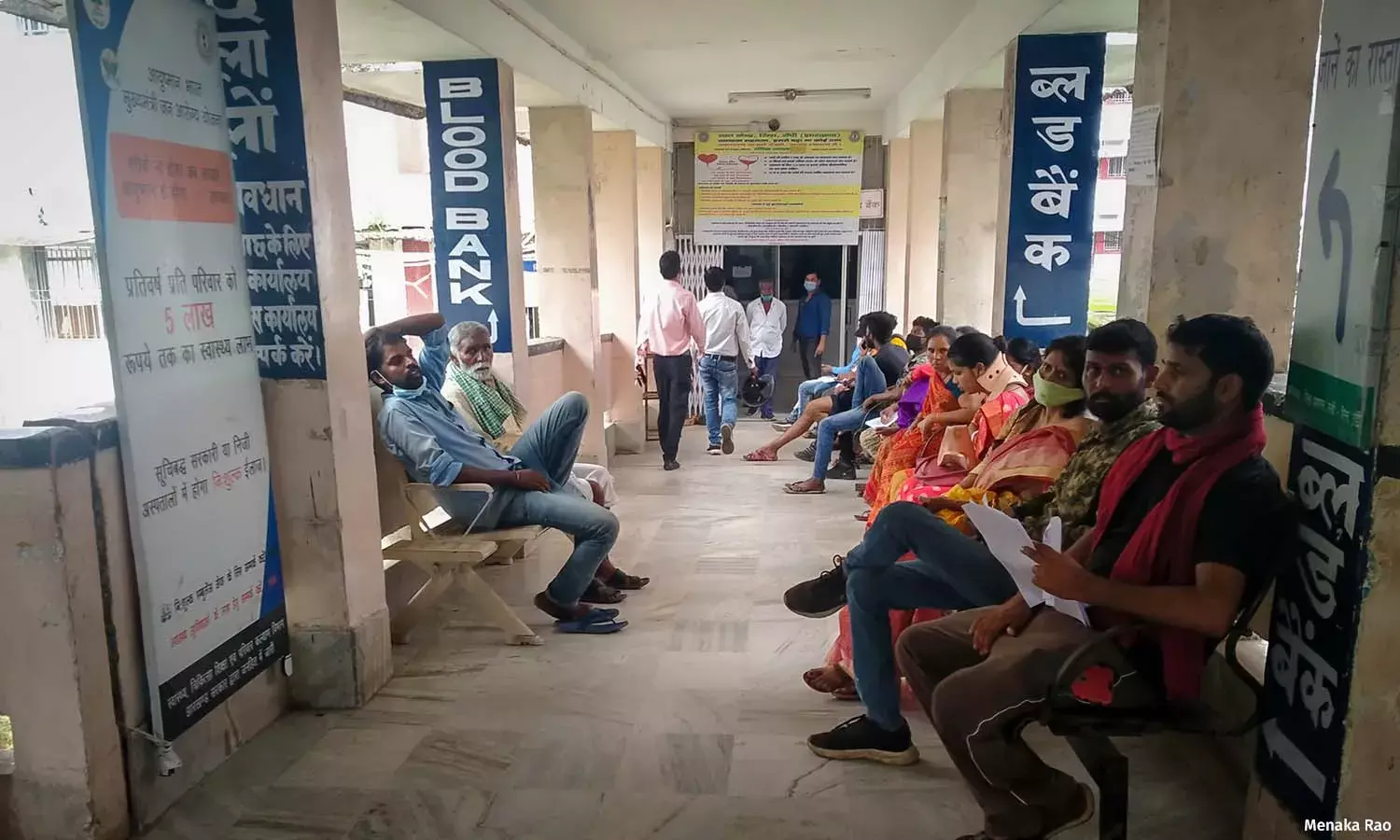
Outside the blood bank of Rajendra Institute of Medical Sciences, Ranchi, in 2022.
New Delhi: In November 2025, when 16-year-old Manisha Kumari went with her mother to get a blood transfusion in Sadar Hospital in Jharkhand’s Giridih district, she was told that her blood group—O negative—was not available.
Manisha is a thalassemia patient and needs transfusions every two weeks. Her family usually arranges for a donor with the same blood group by asking local activists, or through their own networks. Since she was not able to find a donor in November, she was told to go to the nearby town of Dhanbad or the capital Ranchi, both of which have medical colleges.
Thalassemia major is an inherited blood disorder where the body does not make enough haemoglobin. Government estimates show India has the largest number of children with thalassemia major in the world—between 100,000 and 150,000. And about 10,000-15,000 babies with thalassemia major are born every year.
The Indian government runs a programme under National Health Mission (NHM) for prevention and management of haemoglobinopathies, or blood-related disorders, which also includes sickle cell anaemia (people suffering from this have abnormal, sickle-shaped haemoglobin). The management of the thalassemia involves regular blood transfusion (at least once in three weeks), iron chelation (to remove excessive iron), and monitoring of the child regularly by trained medical professionals.
Manisha’s mother Muniya Devi took her to Dhanbad’s Shahid Nirmal Mahato Medical College. By the time she reached the hospital, Manisha’s blood haemoglobin level had fallen to 3.2 gram per declitre (normal level is 12 gm/dL) and further to about 2.5 gm/dL.
Chronic anaemia can cause symptoms such as weakness, fatigue, dizziness, fainting, chest pain and palpitations. Haemoglobin levels less than 6.5 gm/dL are life-threatening. Among anaemic people who do not have thalassemia, guidelines recommend transfusion of packed red blood cells for levels under 7 gm/dL. For thalassemia children, guidelines say that the haemoglobin levels should be maintained up to 9-10.5 gm/dL.
Manisha got one unit of blood after much pleading, when a resident doctor decided to donate blood on her behalf. A lab technician told IndiaSpend that O-negative blood is usually in short supply.
Stock at Giridih's Sadar Hospital Blood Bank on 1/8/2022. This is the only blood bank in the district
This is a usual occurrence for patients with thalassemia. Relatives have to find a way to get blood every month and access is not guaranteed for many of these children, especially those who live in small towns and rural areas. And so, it often turns into a life-threatening emergency.
This is the first of a two-part series on availability of safe blood in the country. The issue has come into focus after five children in Jharkhand’s West Singhbum and six in Madhya Pradesh’s Satna with thalassemia contracted the Human Immonodeficiency Virus or HIV, allegedly from blood transfusions.
The Jharkhand High Court recently ordered police to file a first information report in the West Singhbum case relating to children.
In January, it was alleged that three people from a family—wife, husband and child—contracted HIV after the mother received a blood transfusion during labour. This despite mandates that the blood should be tested for at least five infections including HIV, Hepatitis B, Hepatitis C, syphilis and malaria.
The Jharkhand High Court heard a clutch of public interest litigations on the issue. One of those was filed by Life Savers, Ranchi run by Atul Gera, a businessman who works extensively on promoting voluntary blood donation, and organising blood donation camps regularly. The trigger for his petition was when a 16-year-old adivasi boy with sickle cell anaemia died allegedly due to a delay in transfusion in 2021.
The boy’s parents said that Rajendra Institute of Medical Sciences (RIMS) refused to give a blood transfusion unless the family produced a replacement donor.
Sickle cell anaemia, another major inherited blood disorder which is widespread among tribal communities, requires lifelong treatment involving primarily the administration of hydroxyurea drug, prevention and treatment of infections, and occasionally blood transfusions. India has about 1.4 million people with sickle cell disease.
On December 18, the Jharkhand High Court stated that the bench had “no hesitation in observing that the respondent-authorities have failed to implement the Objective 8.5 of the National Blood Policy”.
The section in the National Blood Policy places responsibility of sufficient blood supply on institutions, in order to serve as a “deterrent to paid blood donors who operate in the disguise of replacement donors”.
It also noted the "absolute lack of manpower” in blood banks, and the fact that there are barely any checks on them by the state. The court ordered that the health department and the State Blood Transfusion Council should ensure that 100% collection of blood is secure by way of voluntary blood donation through blood donation drives.
“We are planning to hire an external agency to take care of increasing the voluntary blood donation in the state,” says Shyam Paswan, additional director, Jharkhand State Aids Control Society, that takes care of blood transfusion systems. “They will be responsible for the entire operation then, while we take care of the laboratory component of blood banks. We shall soon issue a tender.”
How to ensure blood is safe?
Ensuring blood is infection-free entails a lot more than just testing. There is a direct correlation with having blood sufficiency maintained by voluntary, replacement-free, remuneration-free donation.
The World Health Organization says that an adequate and reliable supply of safe blood can be assured by a stable base of regular, voluntary blood donors—who give blood or blood products of their own free will, receive no payment in cash or kind, and are not replacement donors.
These donors are also the safest as the prevalence of bloodborne infections is lowest among this group. These voluntary donors can be reached through blood donation camps or people walking in voluntarily to donate blood once in three months.
All donors are supposed to go through a selection process. For example, those with illness or fever, or those engaging in risky behavior such as using injectable narcotics would not be selected for blood donation.
Family/replacement donors are those who give blood when a member of their family or community needs it. In most places in India, it is an unofficial rule for patients to provide replacement donors for units to be used by the patient. Families often send out messages on social media seeking blood donors.
This is not as safe as voluntary donation. People can conceal their health status or their lifestyle behavior in their eagerness to donate blood or fear of displeasing or distressing their family.
There may be hidden donation systems or other forms of payment provided by patients’ families.
Several studies have shown that as compared to voluntary donation, replacement blood donation throws up more infected blood. The government claims that 70% of blood donation is voluntary.
“Voluntary blood donation is definitely not 70%. It is definitely the other way around (meaning replacement/remunerative blood donation is 70%),” said Vinay Shetty, chief executive officer at LifeBlood Council, a nonprofit working on voluntary blood donation and prevention, care and cure of thalassemia. “It is criminal to make a family run around to find blood donors when their loved one is sick.”
Muniya Devi says they look for blood every month. “Jaan hai, chod nahi sakte hai. (It’s her life, we cannot abandon it).”
In small towns and rural areas, blood units are simply not available at most times of the year. In 2022, for instance, this writer had reported how a patient's relative is asked to find a donor with the exact blood group, which is transfused after testing. This writer also met several children with thalassemia in Jharkhand and Chhattisgarh who were in a situation like Manisha’s, but died as a result of not getting blood. One family admitted to paying for blood donations, and transfusing it outside a blood bank, just before their child died. Many people admitted to paying donors for blood, with no knowledge that it is illegal.
This despite the fact that it is a practice in most blood banks that for children with thalassemia and sickle cell disease, among a few other chronic conditions, transfusions are “free.” “Free” blood transfusion means the patient will not be asked for replacement.
As per the data submitted by the state, Jharkhand state had voluntary blood donation of approximately 15% in July and August last year.
“The government submitted voluminous records—approximately 600 pages—of unanalysed records of blood banks, including donor names sometimes. We analysed it and realised that the total voluntary blood donation in the state is only approximately 15%,” said Gera.
The blood banks often pass off replacement donation as voluntary, he added, and they impressed upon the courts to only count blood donation drives as voluntary, which the court accepted.
After the Chaibasa incident, the licenses of 17 blood banks in the state have been canceled.
Blood levels dangerously low
Children with thalassemia, sickle cell anaemia or those in need of constant blood transfusions live more precarious lives. One of the leading causes of death among thalassemia children is a severe drop of haemoglobin, among other factors such as iron overload, a 2020 study based in Karnataka showed.
Manisha said that when she is due to get a transfusion, she knows her haemoglobin levels have fallen as she is unable to walk around, loses appetite, and is unable to do much by herself. She has dropped out of school because of her illness.
Her blood haemoglobin levels often fall to 5 gm/dL or lower by the time she goes in for blood transfusion. Maintaining 9-10.5 gm/dL pre-transfusion, as the government’s guidelines prescribe, is simply not possible where blood supply is always scant. This writer found that in many areas of Jharkhand and Chhattisgarh, the blood haemoglobin levels of children with thalassemia routinely fell up to 7 gm/dL.
Sohail, a 15-year-old who has thalassemia, was also sent in November from Giridih’s Sadar hospital to Ranchi’s RIMS for blood transfusion. “When he got a blood transfusion, his blood haemoglobin level was 3 gm/dL. Even drawing blood was becoming tough,” said his mother Jamila Khatoon.
Sohail has been getting transfusions since he was three months old and now needs one every 15 days. Jamila said she does not remember his blood hemoglobin levels being above 7 gm/dL.
The National Health Mission Guidelines state that thalassemia management should include not just timely blood transfusion, but also iron chelation (removing excess iron from body), and management of complications.
The Jharkhand High Court in their order also noted the lack of data on essential medicines such as iron chelators (for thalassemia) and hydroxyurea (for sickle cell disease) and doctors trained to handle these ailments in the nine day-care centres across Jharkhand state.
Blood testing
Before the Chaibasa incident, many laboratory technicians in Jharkhand were using the rapid blood test kit (which have much longer window periods up to 90 days), a practice not recommended under the National Standards for Blood Centres and Blood Transfusion Services, 2022, as admitted by at least two workers from blood banks IndiaSpend spoke to. Only higher tests such using equipment such as Enzyme-Linked Immunosorbent Assay (ELISA) / Chemiluminescence, 36 Immunoassay (CLIA) should be used.
A major reason why the rapid blood test was also used was because of the not having assured stock of blood. “Patients’ relatives used to fret, and we would resort to doing just a rapid blood test instead of Eliza test,” said a blood bank worker on condition of anonymity.
On October 31, according to meeting minutes reviewed by IndiaSpend, the government decided to implement universal NAT testing (such as RTPCR or TrueNat used for COVID tests) while allowing Eliza fourth generation or CLIA testing till then.
“NAT testing is only available in RIMS, Ranchi,” said Paswan of JSACS. In the government sector, this ELIZA fourth generation is in Ranchi, Jamshedpur and Dhanbad, sources said.
“All our blood samples are now being sent to Ranchi’s RIMS. It sometimes takes a day and a half or even two days for the test results to come. Now we do not have any provision for transfusing blood units during an emergency,” said Ramesh Yadav, a social worker in Giridih who helps out thalassemia patients and other people with chronic ailments in need of blood donation.
With the ban on replacement donation from the state, there is a lot more pressure on blood bank officials to ensure voluntary blood donation. “There are a lot more camps organised at block level now,” said a blood bank personnel. “But some blood groups are still in short supply. We cannot help but ask patients to get donors in such cases.”
(Menaka Rao is a journalist based in Delhi. She currently works with The George Institute of Global Health as a Project Communications Manager for the Urban Shade Project.)
We welcome feedback. Please write to respond@indiaspend.org. We reserve the right to edit responses for language and grammar.