
How Extreme Heat Affects India's Informal Women Workers
As heatwaves intensify, informal women workers are losing income, productivity, and protection—while policy response struggles to catch up
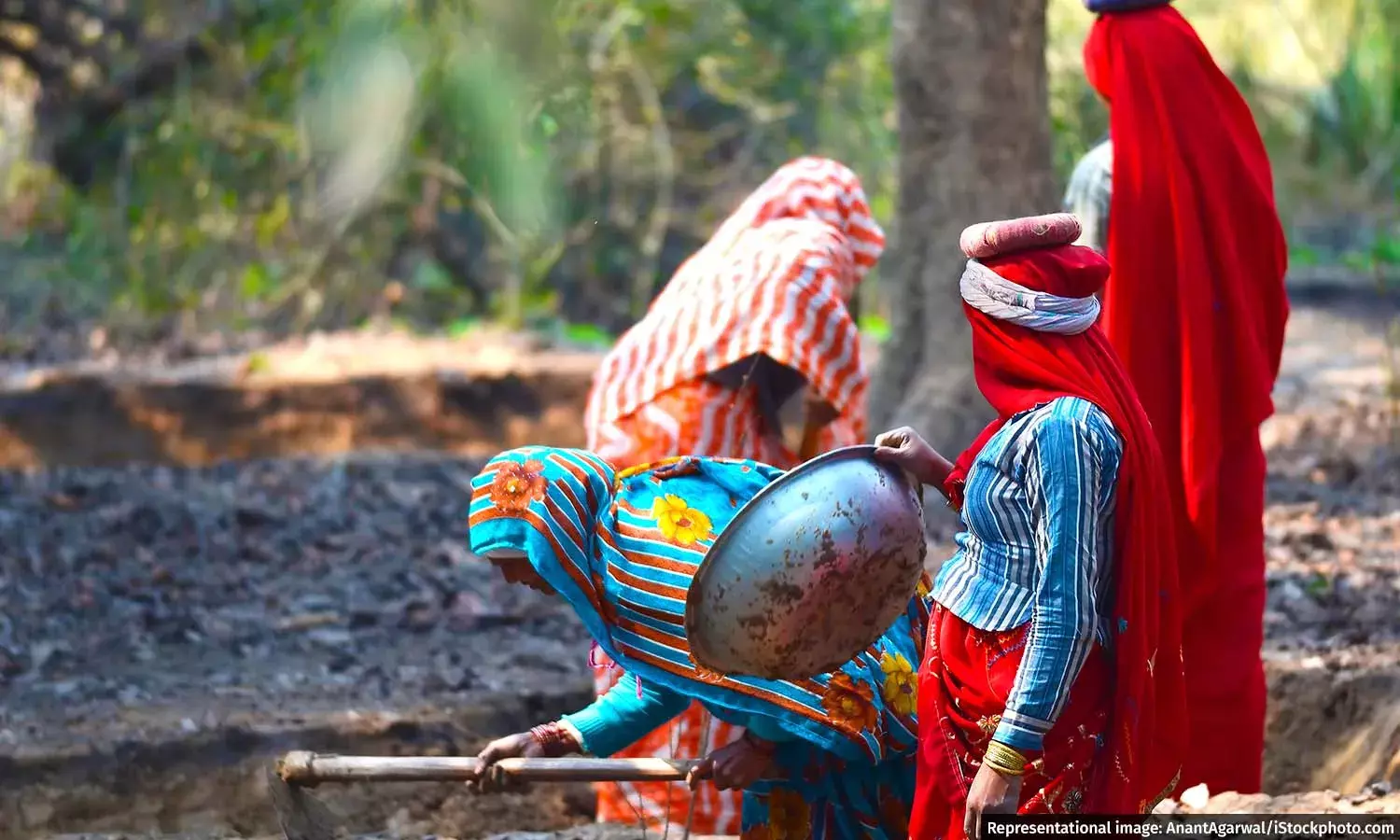
Visakhapatnam: Every summer, millions of Indians in informal work lose income they cannot afford to lose. They work slower in extreme heat, take unpaid sick days, or stop work entirely when temperatures become unbearable. They have no paid leave, no air-conditioned workplaces, and no financial buffer.
Women workers are more vulnerable: They are concentrated in the most insecure segments of informal work, and continue to shoulder an inordinate burden of domestic and caregiving work. And each heatwave means choosing between health and income—and often losing both.
In 2023, extreme heat cost India an estimated 181 billion potential labour hours, translating into income losses of about Rs 13 lakh crore (about $141 billion), according to The Lancet’s 2024 report on climate and health policy priorities for India.
Farm and construction workers bear the brunt, as do informal workers outside and at home, as IndiaSpend reported in April 2025. Women comprise only 23% of those employed in India's informal sector, as we reported in May 2021, but 92% of Indian women in paid jobs are in the informal sector.
Agriculture employs about 60% of informal women workers, and nearly all agricultural work (99.7%) for both men and women is informal. Women are also heavily represented in construction, domestic work, and home-based enterprises, much of it physically demanding, seasonal, and exposed to high temperatures.
Without formal contracts, paid leave, or social security, even short work disruptions caused by extreme heat translate directly into lost income.
In 2023, every person in India was exposed to more than 2,400 hours—or nearly 100 days—of conditions where light outdoor activity posed at a least moderate heat stress, the Lancet report noted, making routine outdoor work increasingly hazardous.
This is getting worse. The year 2024 saw record heat, when temperatures were 0.65°C above the 1991-2020 average, according to the India Meteorological Department. And 2025 was 0.28°C warmer than the long-term mean.
Although women and informal workers are routinely identified as vulnerable, gender-specific risks such as unpaid care work and home-based labour are rarely translated into targeted protections. Evidence from national surveys and recent field studies suggests that this gap leaves informal women workers facing repeated income loss during heatwaves, with limited access to compensation or social protection.
Why women’s work is vulnerable to heat
Global evidence indicates that heat-related income losses are systematically gendered. The 2024 Unjust Climate report by the Food and Agriculture Organization finds that female-headed rural households in low- and middle-income countries lose more income than male-headed households as temperatures rise. On average, the annual income gap due to heat stress was estimated at 8%. Each 1°C increase in long-term average temperature is associated with a 34% decline in income for female-headed households, relative to male-headed households.
“Gender is a key determinant of health, intersecting with education, livelihood, and decision-making power. These together determine whether a woman can manage heat risk,” says Rajalakshmi Ramprakash, a gender consultant.
Women’s economic vulnerability to heat is shaped not only by where they work, but by how much total labour they perform. The Time Use Survey 2024 shows that women spend over five hours a day on unpaid domestic work and more than two hours on caregiving compared to just over an hour each for men. When heatwaves force women to cut back on paid work, their overall workload does not decline; income does.
This burden is compounded, as we said, by the structure of women's employment. Women are concentrated in segments of informal work with the highest poverty risk.
The pyramid shows poverty risk rising from top (formal employees) to bottom (contributing family workers)—categories where women are concentrated
Source: Women in Informal Employment Globalizing and Organizing
The framework on informality above, by Women in Informal Employment Globalizing and Organizing, shows that poverty risk rises for own-account workers, casual labourers, and contributing family workers workers who support family enterprises without formal pay—categories dominated by women.
Heat reduces women's earnings through two main pathways: fewer hours worked due to absenteeism and/or illness; and lower productivity from slower work pace or reduced output, explains Saudamini Das, professor at Institute of Economic Growth, Delhi. “If you don’t have any coping mechanisms like cooling at home or at work, either your hours fall or your efficiency falls, and in both cases income declines,” she adds.
“In piece-rate and daily-wage jobs, women often stay at work during extreme heat but produce less, which directly lowers earnings,” says Vidhya Venugopal, professor of occupational and environmental health at Sri Ramachandra Institute of Higher Education and Research (SRIHER), Chennai.
Dependence on daily wages, outdoor work, home-based work in poorly ventilated homes, and heavy unpaid care responsibilities magnify the economic impact of rising temperatures on women.
Organisations such as the Self-Employed Women’s Association (SEWA) work with women in sectors including waste recycling, street vending, salt pans, and home-based production to provide limited income protection during heatwaves. Most informal women workers, however, remain outside formal labour protections.
What does the actual income loss look like? Recent surveys are beginning to quantify it.
Measuring income and wage loss
A 2025 survey by the MS Swaminathan Research Foundation (MSSRF), covering more than 3,300 women across 15 districts in seven states, found that 97% of respondents reported income losses during peak summer months between April and June. On average, women lost more than Rs 1,500 in wages—with agriculture, construction, and informal service work, together accounting for about 70% of female employment most affected.
“Women’s vulnerability to heat is not an isolated individual experience; it is shaped by work conditions, wages, and care responsibilities,” said Ramprakash, who was involved in the MSSRF study.
IndiaSpend reported in 2020 that official surveys such as the Annual Survey of Industries provide gender-disaggregated data only for regular employees, leaving contract, casual, home-based, and contributing family workers largely invisible in official statistics.
“We do not collect gender- or age-disaggregated data on heat impacts. Without that evidence, effective policy design becomes difficult,” said Deeksha, vice president and medical director at Vasavya Mahila Mandali, a non-governmental organisation working to empower women, children and families.
SEWA’s 2023 survey of more than 800 self-employed women across Delhi, Uttarakhand, Jharkhand, and Madhya Pradesh provides sector-specific detail. Women working in agriculture, construction, street vending, domestic work, home-based production, waste segregation, animal husbandry, and forest-based activities reported that rising temperatures were increasingly unseasonal and harmful to livelihoods.
About 82% said extreme heat had already reduced their ability to work safely. Outdoor workers reported slower pace and shorter hours, while home-based workers reported indoor temperatures exceeding 50°C, spoiling stock and reducing output. Agricultural workers described erratic temperatures damaging crops and cutting yields.
These aren't minor adjustments. In Delhi, shaded workers lost about 20% of output on hot days, compared to roughly 25% among unshaded workers. For piece-rate workers—who are paid only for what they produce—a 20-25% productivity drop means a 20-25% income drop.
Evidence from South India shows similar patterns. A study of 3,000 informal workers found that 91% experienced productivity loss due to heat. Each unit increase in heat stress, measured using the Wet Bulb Globe Temperature (WBGT), a metric that combines heat, humidity, wind, and radiation, raised the likelihood of productivity loss by 339% for women. Dehydration increased the likelihood of productivity loss several-fold.
In the absence of government compensation schemes, small programmes by civil society organisations are attempting to fill the gap. For instance, SEWA’s Extreme Heat Micro-Insurance is a parametric insurance product, meaning payouts are triggered automatically when temperatures cross predefined thresholds, rather than requiring workers to file claims. The programme began with about 21,000 women in a 2023 pilot.
Building on this approach, the Women’s Climate Shock & Insurance Initiative (WCSI), launched in April 2024 with SEWA, Climate Resilience for All, and Swiss Re, combines parametric insurance with lower-threshold cash assistance, early warning systems, and protective tools such as shade and cooling equipment.
During the 2024 heat season, the initiative supported about 50,000 women across Gujarat, Maharashtra, and Rajasthan, disbursing nearly Rs 5 crore (about $600,000) to offset lost earnings and health costs.
What data and policy miss
Despite growing evidence that extreme heat reduces women’s earnings, gaps remain in both data and policy. Official statistics rarely capture informal work realities: wage data are not gender-disaggregated for contract or casual workers, and productivity losses, reduced hours, and income foregone due to heat are not systematically tracked. As a result, the economic consequences of heat for women in informal sectors remain poorly quantified.
Governments have introduced Heat Action Plans (HAPs) at state, district, and city levels. A 2024 review by the Centre for Policy Research assessed 37 plans across 18 states and found that only two conducted vulnerability assessments, and only 11 included any funding mechanisms.
While women, children, the elderly, and informal or outdoor workers are routinely listed as vulnerable, targeted interventions especially those addressing income loss—remain limited. Also, HAPs rarely include paid heat leave, disaster compensation, cooling infrastructure, or protections for home-based and domestic workers. Informal workers also remain outside labour inspections and occupational health frameworks.
Experts warn that without assured financing, legal backing, and localised planning, HAPs are unlikely to prevent heat-related income and productivity losses among informal workers.
“Heat Action Plans focus on preventing illness and death but largely ignore work conditions, income loss and gender-specific risks, leaving informal women workers effectively invisible in heat governance,” says Venugopal.
“Heat Action Plans often lack legal and bureaucratic clarity, and responsibility for enforcement is unclear,” says Tamanna Dalal, senior research associate at the Sustainable Futures Collaborative and co-author of the CPR report. “In several cities, labour officials were not even aware that a plan existed, which shows how peripheral worker protection still is in heat planning.”
IndiaSpend reached out to the ministries of labour and employment, and women and child development for comment on the steps being taken to support informal women workers and their incomes. We will update this story when we receive a response.
We welcome feedback. Please write to respond@indiaspend.org. We reserve the right to edit responses for language and grammar.