
As India Braces For Summer, Informal Workers Have Little Heat Protection
Access to water, toilets and shade becomes scarce for both indoor and outdoor workers during summer
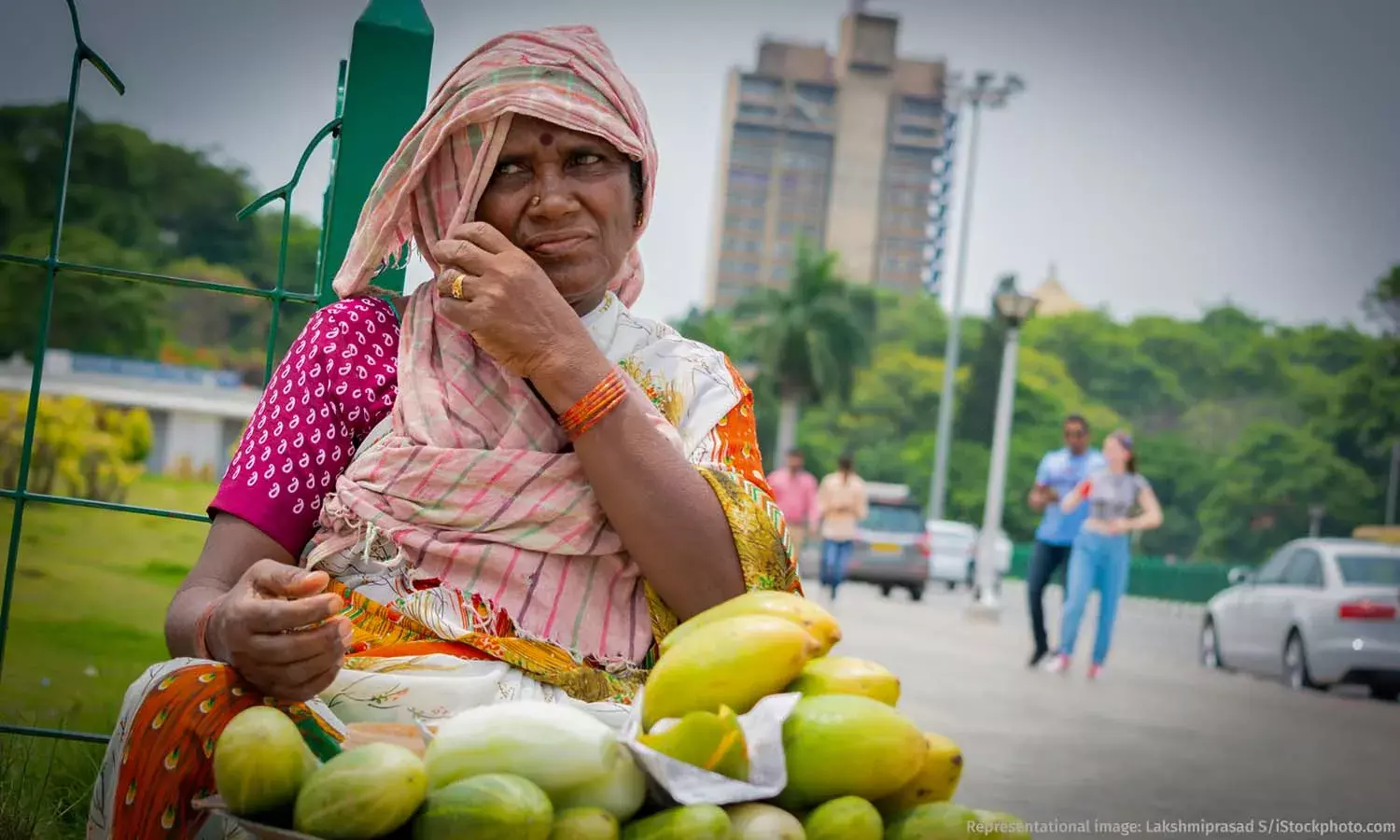
Mumbai: “Of course the heat is increasing. My eyes burn,” said Sangeeta Sonawane in Mumbai’s Borivali on a hot April day. Sonawane sets up her stall on the street, near the local railway station, at 10 a.m. and spends 12 hours selling vegetables. In the peak afternoon, she uses a piece of thermocol or wraps a dupatta over her head to shield herself from the heat.
This summer, places such as Mumbai already reported a heatwave in March, and the India Meteorological Department has forecast more heatwave days and warmer nights in several parts of the country.
Every summer, millions of Indians in informal work lose incomes to extreme heat, as IndiaSpend reported in February 2026. They work slower, take unpaid sick days, or stop work entirely when temperatures become unbearable. They have no paid leave, no air-conditioned workplaces, and no financial buffer.
Globally, more than 2.4 billion workers are exposed to excessive heat, resulting in more than 22.85 million occupational injuries each year, according to the World Health Organization. More than one third of all persons who frequently work in hot conditions experience physiological heat strain.
In addition, for every degree increase beyond 20°C in Wet-Bulb Globe Temperature—a measure of heat stress that takes into account air temperature, humidity, wind speed, sun angle, and cloud cover—productivity decreases by 2-3%.
India is projected to lose about 5.8% of working hours in 2030, up from 4.3% in 1995, the International Labour Organisation estimated. Given its large population, the country is expected to lose 34 million full time jobs in 2030 as a result of heat stress—with agriculture and construction, the sectors with the highest number of workers, expected to be most affected.
In 2023, extreme heat cost India an estimated 181 billion potential labour hours, translating into income losses of about Rs 13 lakh crore (about $141 billion), according to The Lancet’s 2024 report on climate and health policy priorities for India, we had reported in February.
Two recent studies showing the impact of heat stress on garment workers and street vendors illustrate the increased vulnerability. The former work in dense factory settings with cramped workstations and poor ventilation.
A study published in February 2026, which surveyed 115 garment workers in Tamil Nadu and Delhi, showed that in the last 12 months, 87% workers reported facing heat-related issues such as headaches, dizziness, weakness and muscle cramps.
Eleven of the 15 factories where the respondents worked have roofs made of metal or asbestos, materials that trap heat indoors. Three in four workers said the heat at their workstations is so intense that it makes them feel unhealthy, “like working in a furnace”. Two in three said the heat affected their ability to work.
About 94% of the respondents were women. Lack of clean toilets or the chance and breaks to access them deters garment factory workers from drinking sufficient water even during summer. As a result, about 97% of female workers reported a burning sensation during urination, the study—conducted by Heat Watch and Tata Institute of Social Sciences—found.
A separate study, of more than 400 street vendors in Delhi-NCR, showed that 70% of vendors lacked access to toilets, clean water and shade, and that access worsened during the heat period. Nine in 10 vendors reported no access to free, clean water while working, according to the study by Women in Informal Employment: Globalizing and Organising (WIEGO).
Despite labour protections being mentioned in heat action plans and government advisories, informal workers remain the most vulnerable to the effects of extreme heat with little institutional protection.
Sangeeta Sonawane, a vegetable vendor in Mumbai’s Borivali, uses a piece of thermocol to shield herself from the heat, but has little protection beyond that.
IndiaSpend reached out to the Union environment ministry, labour ministry and the National Disaster Management Authority for comment on the measures being taken to mitigate the impact of extreme heat on labourers. We will update this story when we receive a response.
Garment workers face serious health issues
More than a third (36.5%) of the garment factory workers surveyed by TISS and Heat Watch reported that although water is available on the factory floor, it can run out or is not clean.
Nearly two in five (38.3%) reported that the toilets are often unclean, 73% reported they do not have running water, 78.3% workers reported that it is difficult to get permission to use the toilets. Further, “45% of workers reported amber to brown urine, an indicator of dehydration and possible kidney strain”, the survey found.
The conditions also affected menstrual health, with 94% women respondents reporting thick white discharge, an indicator of vaginal yeast infections commonly caused due to hot and humid conditions. “It is also reflective of a pervasive crisis in urinary tract health linked to poor sanitation,” the study noted. “Alarming qualitative reports include workers passing blood in their urine (hematuria) during peak summer.”
Nearly four in five workers (78.3%) said they avoid taking breaks “because they worry about not meeting the assigned production target”. Workers reported having fixed break times, but said it is “difficult to take an extra break even if they feel tired or hot”.
The researchers developed an index that combined environmental load, physiological strain, metabolic load and adaptive capacity to gauge how much heat stress workers were facing. The majority of workers were in the ‘high stress’ category, while a quarter were in a ‘critical’ state.
“A few states, such as Tamil Nadu, had set maximum temperature thresholds for factory units under the Factories Rules 1950, with corresponding guidelines for the factory inspectorate on the action to be taken if temperatures exceeded these limits. However, there is a need for a stronger inspectorate system to ensure effective implementation,” said Vasundhara Jhobta of Heat Watch and an author of the report.
“Additionally, heat stroke, as well as other illnesses related to extreme heat, should be recognised as occupational diseases and covered under the Employees’ State Insurance Act, which is not the case at present” said Jhobta.
Water, washroom, shade
Outdoor workers have it even worse.
Shobha Devi is a flower seller in Santacruz. She does not have a fixed station—she just stands in the busy market areas holding flowers and gajras (flower strings) for sale.
“This heat is nothing. May is the worst,” said Devi, who carries water and food from home. Sometimes, she brings her toddler boy, a four-year-old, along. “Kya karoon? (what should I do)” asked Devi, when asked if the toddler can be protected from the heat.
There is a municipal toilet nearby. She lives in Virar, an hour by the local train, and cannot return home during the peak heat hours.
WIEGO surveyed 519 street vendors across 17 markets before the beginning of summer heat in 2025 and revisited the same sites between July 8 and 18 with 494 street vendors. The vast majority (89%) of vendors reported no access to free, clean water while working and more than 70% street vendors had no access to toilets. Where there were toilet facilities, most required payment and very few were designated for women.
“This indicates that, while national programmes may have expanded sanitation coverage overall, those trading in public space have largely been excluded,” the policy brief stated.
In Round 2, 79% of vendors reported seeking medical attention for heat-related illness—for themselves or a family member—a near four-fold increase from Round 1.
Anup Yadav, a street vendor in Borivali, has access to water from a local tap but he has to pay Rs 200 a month for it. He is also a ‘floater’ who is on his feet all day selling bananas, but most of his customers come only in the evening.
“Dopahar me zyada dhanda nahi hota hai abhi (Not much business happens in the afternoon hours in the summer),” said Yadav.
Anup Yadav is out to sell bananas for about 12 hours every day, but the summer heat affects his business.
Nearly every respondent (96%) reported seeing fewer customers, and 90% said they reduced their working hours due to extreme heat. Many (72%) lost stock to heat damage. The financial strain was evident as borrowing nearly doubled, with women taking on more debt than men.
“For all street vendors in fact, buying drinking water and paying to use toilets is an added expense in summers, as opposed to middle class people like us who receive subsidised water in their homes,” said Shalini Sinha, Asia Strategic Lead of the Urban Policies Program at WIEGO. Women are particularly vulnerable, she explained.
Vendors reported that municipal authorities often do not let them put up umbrellas for shade because it is then perceived as a pucca structure and therefore, encroachment.
Sinha believes that when designing vending zones under the Street Vending Act, cities should focus on making them climate-resilient vending zones.
Last year, the National Hawkers’ Federation had written to the Union government to issue national guidelines to protect street vendors from heatwaves.
“Most heat action plans don't give any suggestions, even for outdoor workers,” said Sinha.
Dileep Mavalankar, one of India’s foremost experts on heat who guided analysis of heat-related mortality during Ahmedabad’s deadly heat wave of 2010 and the development of Ahmedabad’s heat action plan, also agreed that most plans do not go beyond mentioning labourers cursorily.
India needs a cadre of industrial hygienists on the lines of the American Congress of Governmental Industrial Hygienists, Mavalankar stated. They measure different parameters at workplaces such as temperature, light, noise, vibration, pollution, chemicals etc. and certify them fit for workers. “Most heat action plans as of now don't pay much attention to workers. They talk about vulnerable populations in general,” Mavalankar said.
“There is a need for parametric insurance wherein labourers can pay a premium at the beginning of the season and if the heat crosses a certain threshold, they can get a payout for those number of days which compensates them for missing work,” he said.
SEWA’s Extreme Heat Micro-Insurance, a parametric insurance product, began with about 21,000 women in a 2023 pilot, and during the 2024 heat season, the expanded initiative supported about 50,000 women across Gujarat, Maharashtra, and Rajasthan, disbursing nearly Rs 5 crore (about $600,000) to offset lost earnings and health costs, we had reported in February.
“If workers work in the heat and fall sick, the medical cost is also an added expense and a burden,” Mavalankar added.
We welcome feedback. Please write to respond@indiaspend.org. We reserve the right to edit responses for language and grammar.