
Why India Needs To Improve Reuse Of Construction & Demolition Waste
India needs to double down its construction & demolition waste recycling, to reduce the carbon emissions of the building sector, prevent illegal dumping and bring in circularity
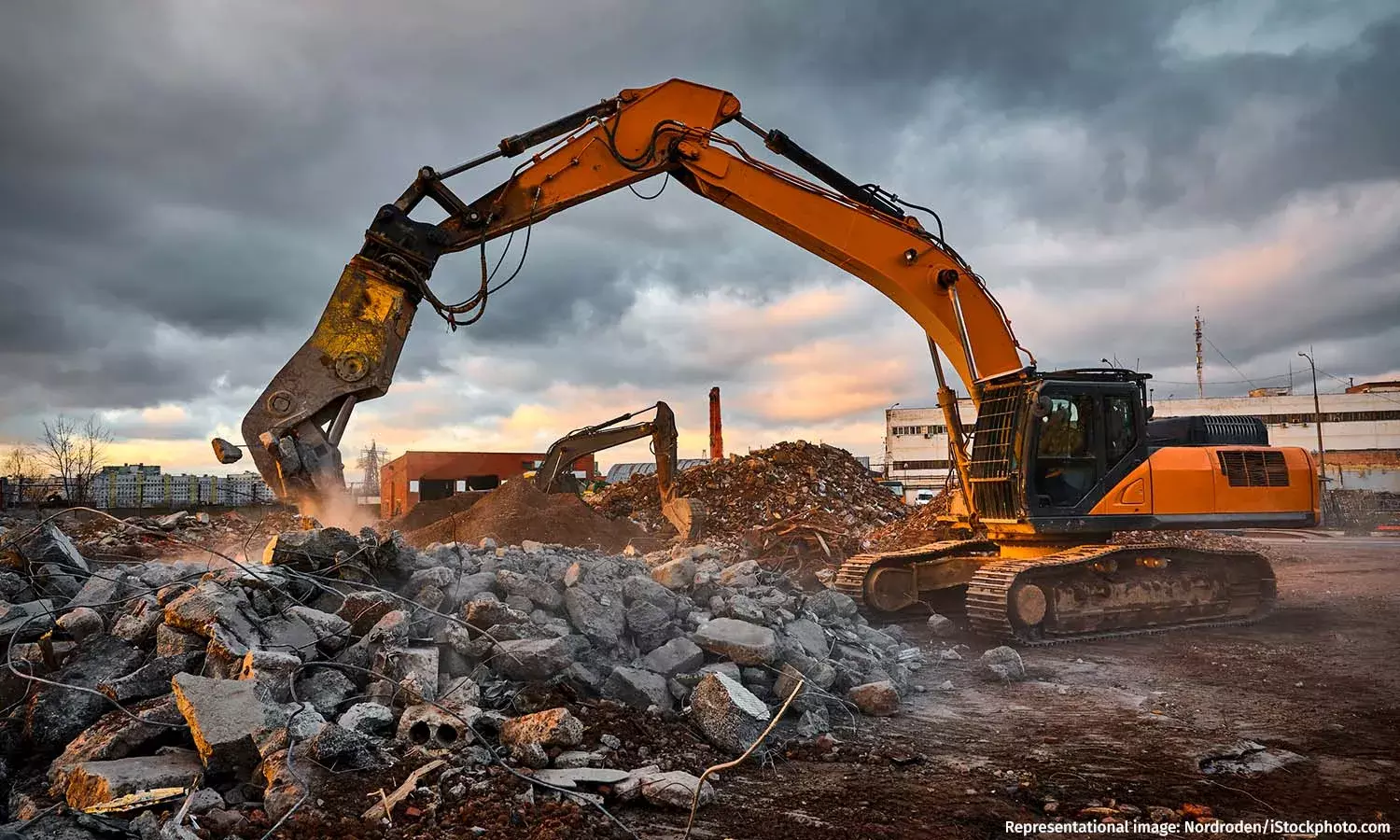
Chennai: In a large yard in southern Chennai, within earshot of honking vehicles on the busy highway nearby, a worker in safety gear deftly sorts the construction rubble on a moving conveyor belt—separating pieces of plastic, wood and other waste. This is one of Chennai’s two plants that process construction and demolition (C&D) waste.
C&D waste is generated during construction, demolition, renovation and maintenance, and comprises items such as soil, sand, bricks, concrete and wood. About 35 kg of waste is generated per square metre of construction, while demolition can result in 10 times that.
India generates an estimated 150 million tonnes of C&D waste every year. Up to 90% can be repurposed, for landscaping, earthworks and civil engineering projects, but only 1% is recycled, government data show.
Material such as metal rods, pipes and wooden fixtures are salvaged by the informal sector, leaving behind the bulky rubble. Of the remaining, between 10–30% is repurposed for landfilling, but the rest ends up on the roadside and in waterbodies. Illegal dumping is a rampant problem, polluting soil, air and water.
The construction sector's environmental footprint makes recycling urgent. The buildings sector in India already emits close to 500 million metric tonnes (MMT) of carbon dioxide (CO2) annually through embodied carbon. Globally, nearly 50% of global resource extraction is directed towards housing, construction and infrastructure development.
With India's rapid urbanisation and infrastructure push, this resource demand will only intensify. Recycling C&D waste is no longer optional—it's essential to reduce both emissions and resource depletion.
India’s first C&D waste processing plant was set up in Burari, Delhi, in 2009. Ahmedabad followed suit in 2014. By 2024, India had 34 such plants across 28 cities, according to a review by the Centre for Science and Environment (CSE). “Now it’s likely to be more than 40,” says Sugeet Grover, programme manager for sustainable buildings and habitat at CSE and one of the authors of the report.
The case for processing
In Chennai, the material that Westart Sustainable Systems generates through processing is bought by a range of users including individuals and large builders. “Large aggregates are used for consolidation and backfilling in foundations, fine aggregates for flooring base and levelling—basically any non-structural use,” says J. Sundaramurthy, project head at Westart Sustainable Systems which operates the processing plants in Chennai, each of 800 tonnes-per-day (TPD) capacity.
Prosperiti Homes, a realtor in Hyderabad, saves up to 40% on raw material cost. “Recycled materials are reintegrated into our projects, significantly reducing landfill dependency and minimising environmental impact,” says V. Venkata Ramana, business development manager at Prosperiti.
The price of recycled C&D aggregates is 15–45% less depending on the aggregate; hence, products made with these aggregates are cheaper.
“There is a proposal to reduce GST [goods and services tax] on products made with recycled materials, which will bring additional cost benefit to end users,” says Manoj Saxena, director of Rise Eleven that operates processing plants in Lucknow and Bakkarwala in Delhi and also manufactures pavers, kerbstones, blocks, planters, etc. from recycled aggregates.
“Almost 95% of it is recycled. The silt is used in making pavers and bricks,” says Manish Bhartia, promoter and managing director of CFlo, a company that manufactures and installs plants across India. “Virgin sand is scarce. We’re using a lot more sand than what can be naturally replenished. Recycling gets us sustainable sand and aggregate,” says Bhartia.
Estimates suggest that India consumes more than 700 million tonnes of sand per year. Most of this is used in construction. Indiscriminate mining of river sand leads to severe degradation, including soil erosion—loss of fertile soil along Brahmaputra being one example—increase in turbidity that impacts aqua-biodiversity, and even drinking water problems as seen in Kerala.

While the government takes up replenishment studies and other initiatives for sustainable sand mining, it also advocates the use of recycled aggregates, which reduce carbon dioxide emission by 40%, estimates show.
”Recycling also solves a huge waste problem. Land lying buried under the waste gets unlocked. Leachate from dumps pollutes the soil and water, and recycling prevents that,” says Bhartia.
Processing C&D waste
C&D waste management involves collection and transportation to the plant, and then processing it. The Greater Chennai Corporation (GCC) uses an online portal or helpline for reporting waste dumps.
“When we get information, we initiate primary collection; our team collects the C&D waste and brings it to the secondary collection centre, which is like a transit point,” says Sundaramurthy of Westart. Premier Precision, an affiliate of Westart, collects the waste.
“From the secondary collection centre, it is taken to the processing plant, employing necessary dust mitigation measures,” Sundaramurthy explains. In the plant, when the rubble moves in a conveyor, workers manually remove waste like plastic and metal. “The rubble goes through a feeder and then a jaw crusher. The crushed material gets automatically sorted size-wise and comes in different channels,” he adds.
In a plant in Lucknow, aggregates get separated in different channels
In Chennai’s private-public partnership (PPP) model, GCC has provided land for the plants and 15 secondary collection centres; and pays a tipping fee for the collection of waste. “PPP is the most widespread model,” says Grover. The first plant at Delhi was also established under this model. Cities such as Chandigarh run the plant themselves under an EPC (engineering, procurement, construction) model where contractors design and build plants that municipalities then operate.
Smaller models also exist, such as the initiative by Prosperiti Homes. “As part of our commitment to sustainable development, we have invested in our own C&D waste recycling machine,” says Venkata Ramana.
The post-processing products vary in size—40 mm to 10 mm aggregates and fine sand, each finding a different buyer for different use, mostly within the construction industry. In the case of the Delhi plant, these products are converted to ready mix concrete, cement bricks, hollow bricks, pavement blocks, kerbstones, concrete bricks, and manufactured sand, thereby reducing the consumption of virgin construction raw material and minimising the environmental hazard due to C&D wastes.
Pots made from processed C&D waste being used as planters in a median in Lucknow
CSE assessed cities based on six criteria including segregation of C&D waste, collection and transportation, and recycling capacity. “In terms of volume, Delhi recycles the most. Some cities perform better in other aspects—Chandigarh holds fairs and exhibits products made from C&D waste, creating awareness among the public," says Grover. “Hyderabad has decentralised its plants. This reduces the distance the waste has to travel—a major cost in the ecosystem.”
“Third-party monitoring curbs illegal dumping in Pimpri-Chinchwad. Noida's plant is good at dust mitigation,” he adds.
Towards better utilisation
In 2012, the Ministry of Urban Development (Ministry of Housing and Urban Affairs since 2017) directed states to set up C&D waste processing plants in cities with more than 1 million population—which was 52 as per 2011 Census and 75 in 2025.
Industry experts point out the lag in implementation.
“The potential is huge. We process only 1% of our C&D waste, whereas developed countries process 80–90%,” says Bhartia.
Germany has one of the highest C&D waste recycling rates, improving from 17% recovery rate in 1994 to 93% in 2019. In effect, less than 10% is landfilled. The country achieved this through strict regulations about waste avoidance and recycling. Many European countries including Germany implement a landfill tax and bans to encourage recycling.
Countries such as the Netherlands and Belgium recycle nearly 100% of their C&D waste. In the Netherlands, recycled aggregates meet 35% of the aggregate demand. A study finds landfill tax and ban to be the most effective in increasing C&D waste recycling.
As for India, weak market for recycled materials, low public and developer awareness, weak C&D waste collection system, are the major reasons for the slow uptake of C&D waste processing and use of recycled products, according to Grover of CSE.
“Delhi has mandated the use of recycled products in government contracts. Municipalities also use it for roads’ base layer,” says Grover. He suggests similar mandates and also incentivising segregation at source as unsegregated waste—given the manual removal of impurities—may result in low quality aggregates.
The processed waste should be used in all construction activities with more than 20,000 m2 built-up area, as per Central Pollution Control Board’s Waste Management Rules that come into effect from April 1, 2026.
IndiaSpend reached out to the Central Pollution Control Board and the Ministry of Housing and Urban Affairs for comment on how recycling and reuse of C&D waste is being improved across the country. We will update this story when we receive a response.
Experts point out that a change in public mindset is also needed.
“There’s a perception that the products are of inferior quality,” says Saxena. “In pavers, for instance, with 5–10% more cement we get the same strength—suitable even for heavy applications such as apartment driveways and petrol bunks.”
To increase the scope of recycled aggregates, Westart is working with IIT Madras to prepare a plastering material.
While Saxena points out that there is no Bureau of Indian Standards (BIS) code for products made from recycled waste, Grover suggests an upgrade for codes such as IS 383: 2016 for coarse and fine aggregates for concrete.
As the Chennai plant ends its shift, Sundaramurthy points out that both their plants run to full capacity and they find takers for all their products, indicating the potential.
Experts say that tapping this potential of C&D waste would bring the construction industry closer to circularity.
We welcome feedback. Please write to respond@indiaspend.org. We reserve the right to edit responses for language and grammar.