
Jal Jeevan’s Cruel Truth In ‘The Land Of Abundant Water’
Tripura’s springs are drying up due to deforestation and erratic rainfall. The govt’s household tap water scheme boasts vast coverage, but in hilly villages, many taps remain dry; some never connected to source
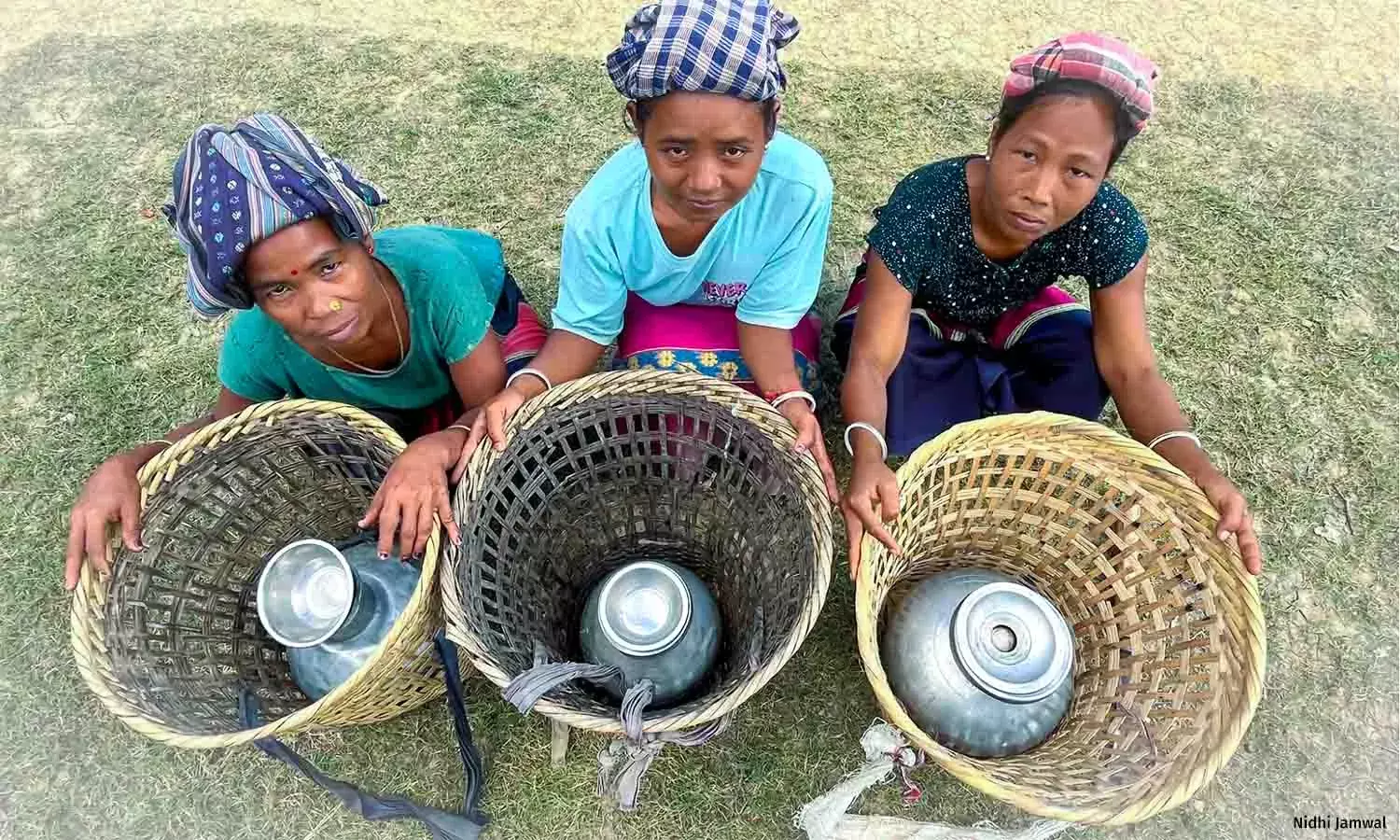
Tribal women in hill villages of Tripura spend a large part of their day fetching water from springs in difficult terrain and suffer various health problems.
Dhalai & Jampui Hills, Tripura: Anita Tripura wakes up at 3.30 a.m., pulls out her teesing—a large bamboo basket with aluminium pots stacked up inside it—and marches downhill in darkness. The teesing is attached to a long cloth-band that hangs from her forehead. A flickering kerosene lamp that she holds lights up the path through the jungle.
Anita and her husband farm about 25 kani (roughly 10 acres) and run a roadside tea stall, but most of her waking hours are spent on water. The 40-year-old who lives in Rajadhan Para (village) in Dhalai district hurries downhill hoping to reach the mountain spring before others do. She fills two to three pots of water and makes her way home before her husband and two sons wake up. This early morning trip takes her between two and three hours. In the summer, this could take twice as long. Most days, she needs to make two such trips.
Anita’s daily struggle for water is the story of thousands of women and girls in hill villages of Tripura. A spring is known as gaati in Kokborok, and twikhor in Mizo (twi means water and khor means source). Villagers complain that springs are drying or disappearing due to deforestation and declining rainfall.
The Union government’s Jal Jeevan Mission shows that 86% households have functional tap connections in Tripura. In Dhalai district, that number is 82% as of December 11. But when IndiaSpend visited villages, the taps were absent; those that exist never saw water. In North Tripura district, villagers say supply is erratic and they end up depending on a spring for daily needs.
Tripura’s name originated from the concept of land of abundant water—a bitter irony today. In the local language, Twi means water and Para implies land. Indigenous communities refer to their home state as Twipra.
The state’s dependence on springs is well documented. A January 2023 report by Central Ground Water Board (CGWB), under Ministry of Jal Shakti, highlights that “springs are the main source of water for a large population of communities living in the hilly area of Tripura”. Local practitioners estimate that there are 600-700 springs in Tripura.
Springs are points on the earth's surface through which groundwater naturally emerges and flows. Springs depend on rainfall, which helps recharge aquifers and keeps the water flowing. Natural factors such as seismic activity affect discharge. Anthropogenic pressures, deforestation, rising tourism, and large infrastructure projects are also affecting mountain aquifer systems and leading to a drinking water crisis.
About 32% of the state’s population belongs to Scheduled Tribes, while 18% belongs to Scheduled Castes. The state has an annual rainfall ranging between 2,338 millimetre (mm) and 2,519 mm in its eight districts. Despite such heavy rainfall, communities suffer from water crises and water-borne diseases; some have even taken to the streets and blocked roads to protest against water scarcity.
And it is not just Tripura. According to a 2018 NITI Aayog report, there are five million springs across India, of which nearly three million are in the Indian Himalayan Region (IHR). Nearly 50% of springs in the IHR region have already dried up or have reduced discharge. An estimated 200 million people depend on spring water across the Himalayas, Western Ghats, Eastern Ghats, Aravallis and other such mountain ranges, implying that more than 15% of India’s population depends on spring water.
More than 15% of India’s population depends on spring water.
High and dry
Broadly, villagers in Tripura blame two factors for the disturbance of their springs—deforestation and climate (declining rainfall and rising heat).
“In the past 20-25 years, monsoon rainfall has reduced in our region,” said Shishukumar Tripura, a 41-year-old resident of Rath Kumar Roaja Para, a tribal village in Manu block of Dhalai district. “Earlier, it used to rain so heavily that we could not even step out of our homes. Now, it rains for a few days and then there is a long dry spell.”
Reduced rainfall is not only affecting mountain springs, he says, but also agricultural activities. Farmers are increasingly shifting from traditional food crops to rubber plantations, which is a water-intensive cash crop. Tripura stands second in natural rubber production in India, after Kerala.
“Earlier we could grow three local varieties of paddy in a year—Baadu variety in January, Joli variety in June and Haus variety towards the end of the monsoon season. All these were four-month paddy varieties,” Shishukumar says. Now, they only cultivate the Joli variety. Most farmers in his village grow natural rubber. Young men migrate to Bengaluru (Karnataka) and Kerala to earn a living.
Prahari Mohan Tripura, Anita’s husband, complained about the decline in rainfall as well. “When I was young, it used to continuously rain day and night in the monsoon season. In winters, we had to wear woollens and light bonfires to keep ourselves warm. But now, both winter and heavy rainfall are a thing of the past,” said the 65-year-old. “Earlier, we had thick forests, which kept our springs alive. But now, forests have been cut down, which is also affecting rainfall,” he said.
Similar voices of concern were raised in Jampui Hills in the neighbouring North Tripura district. Jampui Hills is the state's highest hill range and a tourism hotspot located on the border of Tripura-Mizoram.
“Rainfall has significantly reduced in the Jampui Hills region. Water discharge from our springs is also declining,” said Lallungawia, an areca nut farmer, and president of Behliangchhip’s village council. “Ours is a hill station and till 20 years back, we did not even have fans in our homes. But now, fans are a necessity and four families in our village also have an AC [air conditioner],” Lallungawia told IndiaSpend.
Prahari Mohan Tripura, a jhum farmer from Rajadhan Para, blames deforestation and decline in rainfall for drying of springs.
A series of recent studies on monsoon rainfall in northeast India have reported a significant decline, with overall annual rainfall also decreasing, except in Mizoram. Meanwhile, both minimum and maximum temperatures in Tripura show “significant increasing trends”.
A 2019 study by researchers at Indian Institute of Tropical Meteorology (IITM) noted that the “rapid decrease” in summer monsoon rainfall “has serious implications on the ecosystem and the livelihood of the people of this region”. Declining rainfall also has a direct bearing on mountain springs and the lives of women and girls in hilly villages of the state.
In Shishukumar’s village, 50 tribal families depend on a single gaati (spring). Naithak Priya’s family is one of them. Women and girls fetch water from the gaati multiple times in a day. The walk is tedious.
“During the summer season, discharge from our spring reduces, and women and girls have to wait hours to fill pots of water. Girls often miss their school as they get late. The school is a kilometre away and children have to walk there,” said Priya, who has a son and a daughter. During the rains, the slopes are slippery leading to fall and injuries but water still has to be fetched.
The 2023 CGWB report stresses that there is a “need to restore and preserve the spring from drying up… by first identifying the recharge area of the aquifers feeding the spring and then taking up artificial recharge works like digging trenches and ponds to catch the surface flow and enhance the infiltration”.
Water or nothing
The onerous task of fetching water falls disproportionately on women and girls. A woman collecting 50 litres daily, the UN-recommended amount per person, for her family of four from a water source 30 minutes away would spend two-and-a-half months a year on this task, IndiaSpend reported in March 2018. Consider the 4-6 hours a day Anita typically spends, and this goes up to three months a year.
In low- and middle-income countries (LMICs), eight in 10 women are responsible for collecting water for their household, as IndiaSpend reported in July 2019. Women are responsible for over 70% of water-related chores and management globally.
World over, women and girls spend 200 million hours every day collecting water, and in Asia, one round trip to collect water takes 21 minutes, on average, in rural areas, as IndiaSpend reported in June 2022.
“My days are spent either fetching water or worrying about it,” Anita told IndiaSpend. “As the monsoon withdraws and the winter deepens, the water flow in our spring steadily drops, and the lines of women waiting to fill water lengthens,” she added in her native Kokborok language.
Summers are worse when the main spring of Rajadhan Para goes dry. “So we walk even longer and further away from our village to find another spring … My head, legs, shoulder, and back hurt all the time. I don’t sleep too well either, worrying about water, but there is no escape,” said Anita. Besides tending to the tea stall, the couple grows kharif or monsoon crops (paddy, maize, and local vegetables) and the land is left fallow in the rabi (winter) season, as part of the traditional jhum (shifting) cultivation practised by farmers in northeast India.
Anita Tripura, a resident of Rajadhan Para (village) in Dhalai district of Tripura, wakes up at 3.30 a.m. to fetch water from a spring downhill.
Some well-off families in Behliangchhip also buy water from private water tankers at a rate of Rs 1,000 for a 500-litre drum. These private operators collect water from local springs and sell it.
“But, the tanker water is not fit for drinking. Hence, women and girls daily make two to three trips to the spring [a kilometre downhill] to fetch water,” said Kimi Ralte, a resident of Behliangchhip. “Between February and March, we wake up at four in the morning to fetch water. Otherwise, we have to wait for hours in the queue at the spring to fill water.”
The effort to fetch drinking water slows development, including education, according to global studies by United Nations Development Programme (UNDP), United Nations Children's Fund (UNICEF) and Oxfam. Being ‘needed at home’ is a major reason why children, especially girls from poor families, drop out of school, as we reported earlier.
Saving the springs
Spring protection and rejuvenation started only last year in the state. The Centre for Microfinance and Livelihood (CML), an initiative of Tata Trusts, has so far ‘treated’ 55 springs through springshed interventions in Dhalai (29 springs) and North Tripura (26 springs) districts. Rajadhan Para’s spring is one of them.
Springshed management involves mapping aquifers, and soil and water conservation measures. These include digging of trenches and constructing brushwood check dams using branches/bushes, stones and soil, to hold rainwater and increase recharge of the aquifers, which feed the springs.
“Tripura’s water challenges are closely linked to declining spring discharge, degraded catchments, and increasing seasonal variability,” Sanjay Singh, executive director of CML, told IndiaSpend, adding that ongoing interventions are showing measurable improvements in discharge and source reliability. In the next two years, CML aims to work on 100 to 200 more springs. Hydrogeological assessments are being carried out and community readiness checked—digging of trenches and maintenance of trenches is the responsibility of local communities.
There are an estimated 600–700 springs in Tripura. Rural women carry aluminum pots (locally known as gola) in bamboo baskets (teesing) to fetch water.
“On average, each hectare of treated area has 125 trenches, which are dug by the villagers. Each trench is 1.5 metre (m) long, 0.6 m wide, and 0.45 m deep,” said Ankush Bhattacharjee, CML’s state lead of Tripura.
Before implementing the project, the local community is informed about the need and the process of springshed interventions. Consent of the gram sabha (village institution) and active participation of villagers is crucial. Permission of landowners, whose land falls under the recharge zone, is also mandatory for the digging of trenches.
In every village where interventions are made, the gram sabha selects eight members, half of them women, to form a Spring Water User Committee (SWUC). This committee oversees digging of trenches and handles operation and maintenance once the work is complete.
According to CML, villagers who dig trenches are paid Rs 300-500 per day depending on the number of trenches excavated, the size specifications, and the hardness of the terrain (e.g., rocky or compact soil). Payment is performance-linked and varies site to site. Typically, 15-30 community members participate in each springshed implementation based on the local requirements.
In the past one year, Centre for Microfinance and Livelihood has treated 55 springs in Dhalai and North Tripura districts. It is also preparing a Spring Atlas of Tripura.
In Rath Kumar Roaja Para, Barun Mohan is the chairperson of the SWUC. The 36-year-old told IndiaSpend how 15 people participated in digging trenches to recharge their village spring. The work was completed two months back.
“Initially, we faced some hurdles as trenches had to be dug on a recharge zone that belonged to three landowners. But, after we explained the benefits, the landowners gave their permission. We will get to know the benefits of our hard work in the coming years,” said Mohan.
Seventy kilometres away in Jampui Hills, CML works on two more springs in Behliangchhip village. About 800 people in Behliangchhip depend on five springs to meet their water needs.
Ramthanzuic is a member of the SWUC of Behliangchhip, where interventions were completed in February this year. “The trenches we dug have been able to hold rainfall from this year’s monsoon. We are hopeful it will help increase discharge from our spring in the coming years,” she told IndiaSpend. “We also regularly remove silt and dry leaves from the trenches so that their water-holding capacity does not reduce.”
Springshed management includes digging of trenches in recharge zones to hold rainwater and increase recharge of the aquifers.
The forest department is also supporting interventions under springshed management as more than 75% of Tripura’s geographical area is under forests. Permission from the department is mandatory to implement soil and water conservation works (such as digging trenches) in forest areas. The department signed a Memorandum of Understanding with CML.
“We are also trying to set up a solar pumping scheme in the Kanchanpur subdivision to supply drinking water under the PM-KUSUM scheme of the central government to promote solar energy,” Suman Malla, divisional forest officer (DFO), North Tripura, told IndiaSpend.
The forest department is also implementing an Indo-German Development Cooperation (IGDC) project titled ‘Climate Resilience of Forest Ecosystems, Biodiversity & Adaptive Capacities of Forest Dependent Communities in Tripura’ (CREFLAT project) under which check dams have been built in in Dhalai and North Tripura districts to store rainwater, promote fisheries and other livelihoods, the DFO said.
A pipe dream
As per the official data of Jal Jeevan Mission - Har Ghar Jal of the Indian government, as we said, 86% of rural households in Tripura have a functional tap connection. In Dhalai district, where Rath Kumar Roaja Para and Rajadhan Para villages are located, the functional tap water coverage is 82%. In North Tripura district where Behliangchhip is situated in Jampui Hills, the coverage is even higher—86%.
But, villagers complain that tap water supply remains a pipe dream for them. In Rath Kumar Roaja Para, a dilapidated concrete structure for tap water connection is visible but it has been taken over by weeds and shrubs, as there is neither a tap nor any water in the pipeline.
“It was constructed about three years ago, under Har Ghar Jal. But the main water pipeline is about a kilometre away,” says Shishukumar. “Our village was never connected to the main water supply. We have not got even a drop of water from the government tap. We completely depend on our spring." According to him, of the 50 households in the village, about 20 families have got a ‘ tap water connection’, but only on paper.
A government water supply connection in Rath Kumar Roaja Para in Dhalai district of Tripura. Villagers claim not even a drop of water has come from it in the past three years.
Similarly, in Behliangchhip in North Tripura, taps are visible but villagers complain that water supply is highly erratic. “It has been two months since we have received tap water supply from the government,” complained Ramthanzuic, standing next to a dry tap on November 15 when IndiaSpend visited her village.
Ralte of Behliangchhip said that on paper, around 200 families in the village have piped water supply. “But, most of the time, there is a problem. Either the motor pump doesn’t function, or there is no power supply, or the water supply machinery breaks down,” she complained. “If all goes well, then a family receives piped water supply once in a week. Even if we store water, it is not enough to sustain us for a week. We still depend on our springs,” she said.
Ramthanzuic, a resident of Behliangchhip village in Jampui Hills, said there was no water supply for the past two months.
The situation is worse at the government boys hostel of Jampui Class-XII School in Behliangchhip. The hostel has 86 boys, who have to walk 1.5 km downhill to a spring to take a bath and wash their clothes.
“We have to buy water from a private tanker and every trip costs Rs 1,000-2,000,” Jogabasi Molsom, a PGT (post graduate teacher) at the school, told IndiaSpend. “We need a lot of water to run the hostel and often have to beg local government officials to send us a tanker, which comes once a week. Right now, the school has a boys hostel only. But soon, a girls hostel for 50 students is being started. We desperately need a regular water supply. ”
“We have to wake up early in the morning to rush to the spring and finish morning chores before the school starts. Villagers also come to the same spring to fetch water and often fights erupt,” said Lalundita, a grade XI student and hosteler.
According to Jal Jeevan Mission, 86% of rural households in Tripura have a functional tap connection. But, the ground reality is different.
IndiaSpend met Sajesh Debbarma, sub-divisional officer, Drinking Water and Sanitation Sub-Division, Dasda, North Tripura at his office in Kanchanpur, about 150 km from the state capital Agartala. He said that the aquifers in North Tripura lacked sufficient water and the terrain was rocky, which made it difficult to dig borewells.
“But we are supplying piped water to a large number of families. In Jampui Hills RD [rural development] block, 77% families are covered under tap water supply,” said Debbarma. “There are two solar-power drinking water schemes in Bangla Bari and Tlangsang villages. Three more such projects are approved,” he said.
He acknowledges that there are geographical challenges of supplying piped water to villages because most hamlets are located at hilltops. Power outages also affect pumping of water.
“The early scientific results of springshed interventions are promising. However, expanding this impact will need committed government support, policy alignment, and close coordination among departments. With this backing, Tripura can secure its springs as a reliable drinking water source for hill communities,” said P. Kasee Sreenivas, senior programme manager, Tata Trusts.
In a few years, if the trenches work or piped water supply is streamlined, Anita might be able to sleep past dawn. Until then, she’ll keep waking up at 3.30 a.m., racing downhill in the dark—knowing that in this land of abundant water, rural women spend up to a quarter of their lives around water.
We welcome feedback. Please write to respond@indiaspend.org. We reserve the right to edit responses for language and grammar.