
No Insurance, Little Sleep, Rs 10,000 A Month: Meet Chhattisgarh's Elephant Trackers
As habitat shrinks and conflict rises, Hathi Mitra Dal volunteers work with forest officials to keep elephants and humans apart
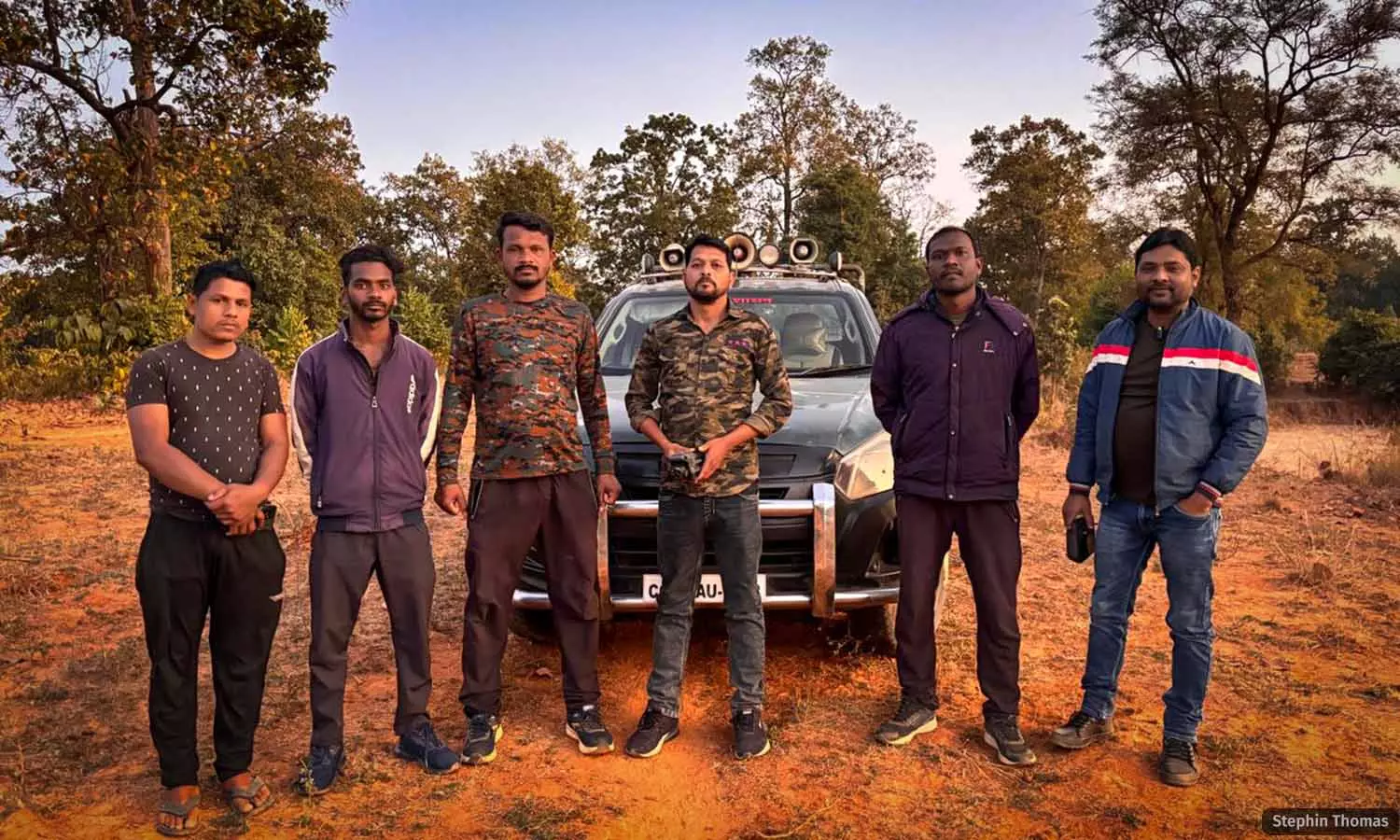
When elephants enter villages in northern Chhattisgarh, the first response often comes from the Hathi Mitra Dal, local volunteers. They track herds through the night, warn farmers, and try to keep elephants away from habitations.
Dharamjaigarh, Chhattisgarh: It has been four hours since the group of six volunteers began combing the area near Jampali village, about 20 km from Dharamjaigarh town in Raigarh district. It is 8 p.m. and the cars navigate bumpy roads in the dark, careful to avoid alarming the elusive herd of elephants spotted in the area earlier in the day. They are equipped with drones, flashlights, walkie-talkies and search sticks.
“The elephants move so quietly,” says 40-year-old Javed Sheikh, a member of the Hathi Mitra Dal, “no one even realises when they enter another area.” The herd they are looking for is locally called the Gautami Dal—two male and eight female elephants, with five calves—known to have damaged houses in the area in December 2024.
Shrinking elephant habitats and corridors for their movement owing to deforestation and urbanisation have led to higher rates of human-elephant conflicts, researchers say. In this context, Hathi Mitra Dal steps in. It is an initiative started by the state government in 2018 to manage human-elephant conflict better. In states such as West Bengal and Assam, this initiative is known as ‘Gaja Mitra.’
The Dharamjaigarh division includes six forest ranges: Chhal, Dharamjaigarh, Boro, Kapu, Lailunga, and Bakaruma. Sheikh and six other volunteers work closely with forest officials across these ranges to track elephant movement and alert nearby villages when herds move close to human settlements.
The forest here is interspersed with farms, and local farmers often use an electrical fence to protect their crops—a practice that can endanger the lives of elephants. In the last five years, 580 elephants died across the country, the government told Parliament in February 2026. Nearly three in four of these were from electrocution.
Between the years 2000 and 2023, Dharamjaigarh forest division recorded 33 elephant deaths, all due to electrocution, the highest mortality in the state, according to a March 2025 report by the Wildlife Institute of India and Project Elephant under the forest ministry. During the same period in the division, 135 people died and 20 were injured in elephant encounters.
The state recorded 218 elephant deaths in this period, 39% (84) were attributed to anthropogenic causes. Further, there were 737 human deaths and 91 injuries in 828 incidents of human-elephant conflicts.
And it is not just Chhattisgarh. In neighbouring Jharkhand, 474 people have died in such conflicts just in five years to 2024, as IndiaSpend reported in December 2024.
An October 2025 estimate, based on DNA-based genetic mark-recapture, puts India’s elephant population at 22,446 elephants. Of these, 451 are in Chhattisgarh. The estimate said that the methodological change means the numbers are not directly comparable with earlier estimates. In 2017, India was estimated to have 27,312 elephants, we had reported.
Elephant herds migrate 350-500 sq km annually through swathes of forests and grasslands known as elephant corridors, which link their habitats, we had explained in November 2018. As of 2023, India had 150 elephant corridors across 15 states, according to a report by the Wildlife Institute of India. About 40% of them had seen increased elephant use. Chhattisgarh has nine identified corridors.
A study in northern Chhattisgarh also found widespread crop damage linked to elephant movement in forest–agriculture landscapes. Researchers recorded 363 incidences of crop foraging by elephants from 60 villages and settlements between February 2019 and February 2020.
Habitat decline, fragmentation leading to conflicts
Historically, elephants were present in northern Chhattisgarh but became locally extinct in the early 20th century, a March 2025 report of the Wildlife Institute of India says. Their return began in the late 20th century, with 18 elephants recorded in 1988, rising to 247 by 2017. The movement is linked to forest degradation in neighbouring Odisha and Jharkhand due to mining, logging, industrialisation and encroachments, which has disrupted traditional movement routes.
Within Chhattisgarh, forests are highly fragmented, especially in the north and central regions, the report noted. Between 2000 and 2024, forest cover declined by 7%, with land converted mainly into cropland (22%) and built-up areas (6%), alongside rising urbanisation. These changes are pushing elephants out of forests and into shared landscapes, increasing the risk of conflict.
“The forest landscape in Dharamjaigarh is fragmented and under increasing pressure from development activities such as the Bharatmala Pariyojana road construction, railway expansion, and mining,” Siddhant Jain, a wildlife biologist with Nova Nature Welfare Society who studies human-elephant conflict across north Chhattisgarh, said. This shrinking habitat, he explained, is pushing elephants towards farms. “Even a relatively small population of elephants is now leading to intense and repeated conflict because the habitat can no longer support their needs.”
An elephant help centre in Dharamjaigarh. A forest guard is present 24x7 to attend to the concerns of villagers.
One morning in 2023, Manwari Bareth and her husband went to collect mahua seeds near their village, Bogiya, about 7 km from the Chhal range. “We were walking towards the forest area at around 6.30 a.m., and picking seeds along the way,” Bareth said. “That’s when we heard a sound. My husband said it must be a falling twig. But in just a moment, we saw the elephant in front of us. We both ran in different directions, and the elephant followed my husband.”
Her children, villagers and the forest department gathered to search for him. “Around 9.00 a.m., they found his body. His chest and shoulder crushed, his body was in a twisted position,” said Bareth, a mother to three sons.
Her family is now afraid to venture out and collect mahua seeds. They still go occasionally, but never alone. “My elder one [age 28] is married and works at an itta bhatti [brick kiln]. The other two [aged 21 and 18] are unemployed; they are looking for jobs,” she said.
Over the years, hundreds of families here have faced loss—of lives, crops, and livelihoods. For many, forests are not just landscapes but a source of survival. Villagers sell oil extracted from the mahua seeds. Even a single productive tree can bring in around Rs 6,000 per household in a month.
The perils in the dark
“Our work is to manage both the elephants and the villagers,” Sheikh said.
In Dharamjaigarh, farmers are increasingly growing crops such as maize and watermelon, which are particularly attractive to elephants. Large fields of these crops can draw herds into agricultural areas, raising the likelihood of conflict. “If there is a big maize field, the entire crop can be destroyed in one night,” Sheikh says.
Farmers whose livelihoods depend on their harvests can become frustrated when herds damage fields overnight. “If crops are damaged, people become angry. We have to face that too,” he adds.
When not tracking elephants, Sheikh and his team visit villages and spread awareness, discouraging villagers from using electrical fencing, and informing them about changes in elephant movement patterns.
For example, Gautami Dal—the herd Javed and his team are tracking this evening—earlier stayed in this forest for six months and then returned to Odisha. But now, they do not return, Sheikh says. They move within Dharamjaigarh and Raigarh.
“Sometimes we don’t sleep for two nights straight, moving from one village to another tracking elephants,” Sheikh says, as his phone buzzes. “I had my first meal of the day only at 3.30 p.m. It has been that busy since morning. This is how it is most days.”
What began as a hobby, driven by curiosity to see elephants up close during youth days, eventually turned into full-time work.
“Villagers were scared of elephants; there was an environment of fear. My friends and I would ride our motorcycles to the area and try to help them,” Sheikh recalls. “At that time we even paid for the fuel from our own pockets.”
“Seeing an elephant once in a while is one thing. But following the same elephant herd every day, driving for hours, protecting villagers, and dealing with problems is not easy,” he adds.
Prakash Bhagat, another Hathi Mitra volunteer from the Chhal range, says he loves wildlife and the jungle. “My father was a deputy ranger in the forest department. Since childhood, I used to travel with him through forest areas and villages,” he says.
Before joining the Hathi Mitra Dal in 2024, Bhagat worked in the corporate social responsibility wing of an energy firm, but returned to farming in his village to stay closer to home.
The daily grind
Tracking begins in the morning, first through documentation of elephant activity. “Every morning, forest guards locate elephant movement by looking for footprints and other signs such as dung or sounds in the forest,” explains Balgovind Sahu, joint divisional forest officer (DFO) of the Dharamjaigarh forest division.
The division has 78 forest guards, supported by 22 foresters, 16 deputy rangers and seven forest officers, Sahu tells us.
“This information is passed from the range office to the division, where the reports are compiled. Once the location of the herd is confirmed, updates are shared through WhatsApp groups in nearby villages so people can stay alert.”
Once the location is roughly identified, volunteers head out to track the herd on the ground. In recent years, drones have also helped volunteers scan large stretches of forest and detect elephant movement.
As Sheikh operates a drone, his eyes fixed on the screen without blinking for any sign of movement, Bhagat looks toward a nearby pond. “The Gautami Dal must have come here to drink water,” he says.
Their goal is always to keep the herds within the reserved forest area. “We do our best to make sure the elephants do not come near the village and stay within the forest range,” Bhagat says.
The Hathi Mitra volunteers are trained to handle different situations beyond basic tracking. “Training happens regularly at the local level,” says Sahu. “We teach volunteers about elephant behavior, how to protect villagers, what to do if elephants enter a village, and the dos and don’ts of managing herds. Over time, this initiative has not only built the skills of our volunteers but also changed the community’s attitude toward elephants and conservation.”
Ajay Yadav, a Hathi Mitra volunteer, unpacks a drone. In recent years, drones have helped the volunteers scan large stretches of forest and detect elephant movement.
The structural challenges
The Hathi Mitra initiative does not have a separate budget yet. “There is no separate fund for this initiative anywhere in Chhattisgarh,” Sahu says. “So far, all funding comes under the general elephant management budget. Volunteers are paid Rs 10,000 a month.
Arun Kumar Pandey, principal chief conservator of forests (development and planning), said there is no scarcity of funds. He cited the budget head for elephant-affected regions under the Chalit Hathi Suraksha Dasta (Mobile Elephant Protection Squad) as an illustration for how elephant-related activities are supported.
“If you think of this work as a source of livelihood, it is impossible; no one would do it,” says Sheikh. “There is no future in this. The risks are high and there is no insurance. You must have the right dedication, otherwise a single day’s experience is enough to leave it.”
Pandey says that the volunteer work under the Hathi Mitra Dal is demanding, and so people keep moving out of the role. For those who have put in years of work, he said, he will write to DFOs to arrange insurance cover.
“I have severe headaches, and I am not used to sleeping during the day, so it can get overwhelming,” Bhagat says. “Most days, I get only two to three hours of sleep. Sometimes we are free around 10 a.m. when the elephants stay in the reserve forest, but we always have to be ready”
The volunteers use WhatsApp for quickly spreading information about elephant movement. The official tracking app (Gaj Sanket) has limitations. A volunteer, speaking on condition of anonymity, said the app does not provide precise locations. “It sometimes only gives a very broad range of detail, like 0-20 km, and never the exact location of the herd. The SMS received are inconsistent, and we can’t rely on it,” they said.
Pandey said the app is dynamic, and that the department will continue rolling out improvements to make it more effective.
The need for community participation
Mahesh Yadav, a fruit seller near the village, says that in many cases, people have to deal with the situation before officials arrive. “Whenever elephants come, we have to act ourselves. We shout and flash lights to scare them away. By the time forest officials reach, the elephants have usually moved on,” he says. “The WhatsApp group is useful though. They keep sharing updates so we can stay alert.”
Heena Rathia, a final year student of arts, says encounters with elephants have been part of life in the village for years. “Sometimes elephants come near our house or into the farm. I have been seeing this since childhood,” she says. “When they enter the fields or pass close to the houses, we inform the forest department and wait for them to come.”
Conservation experts say long-term solutions must recognise the role of people who live closest to wildlife habitats.
“You cannot think about conservation without including the people who share the landscape with these animals,” said Meetu Gupta, founder member and secretary of the Conservation Core Society, a Raipur-based organisation working across central India on wildlife conservation and protection.
Gupta says managing human-wildlife conflict requires a broader approach. “With species like elephants, leopards and sloth bears, solutions have to be collaborative. It is not only about protecting wildlife but also about addressing community concerns, livelihoods, and safety.”
She also points to the need for strengthening the capacity of Hathi Mitra volunteers. “They would benefit from more structured training in wildlife behaviour, conflict mitigation, and field safety,” she says. “If volunteers are also trained to systematically record observations from the field, that information can help researchers and forest managers develop better strategies to manage conflict in the long run.”
The next morning, the Gautami Dal eventually reached the location where the volunteers had first begun their search, Jampali. The herd prefers staying close to the mountain and hilly areas, says Bhagat. “The next day, a forest guard noticed the footprints, and the tracking report was updated as per the observation.”
This story is part of the Climate Narrative Hub’s work, developed in collaboration with The Migration Story.
We welcome feedback. Please write to respond@indiaspend.org. We reserve the right to edit responses for language and grammar.