
How African Swine Fever, Policy Gaps Are Devastating Assam’s Pig Farmers
With no vaccine and outbreaks reported across nearly 400 epicentres, Assam’s pig farmers are bearing the brunt of African Swine Fever
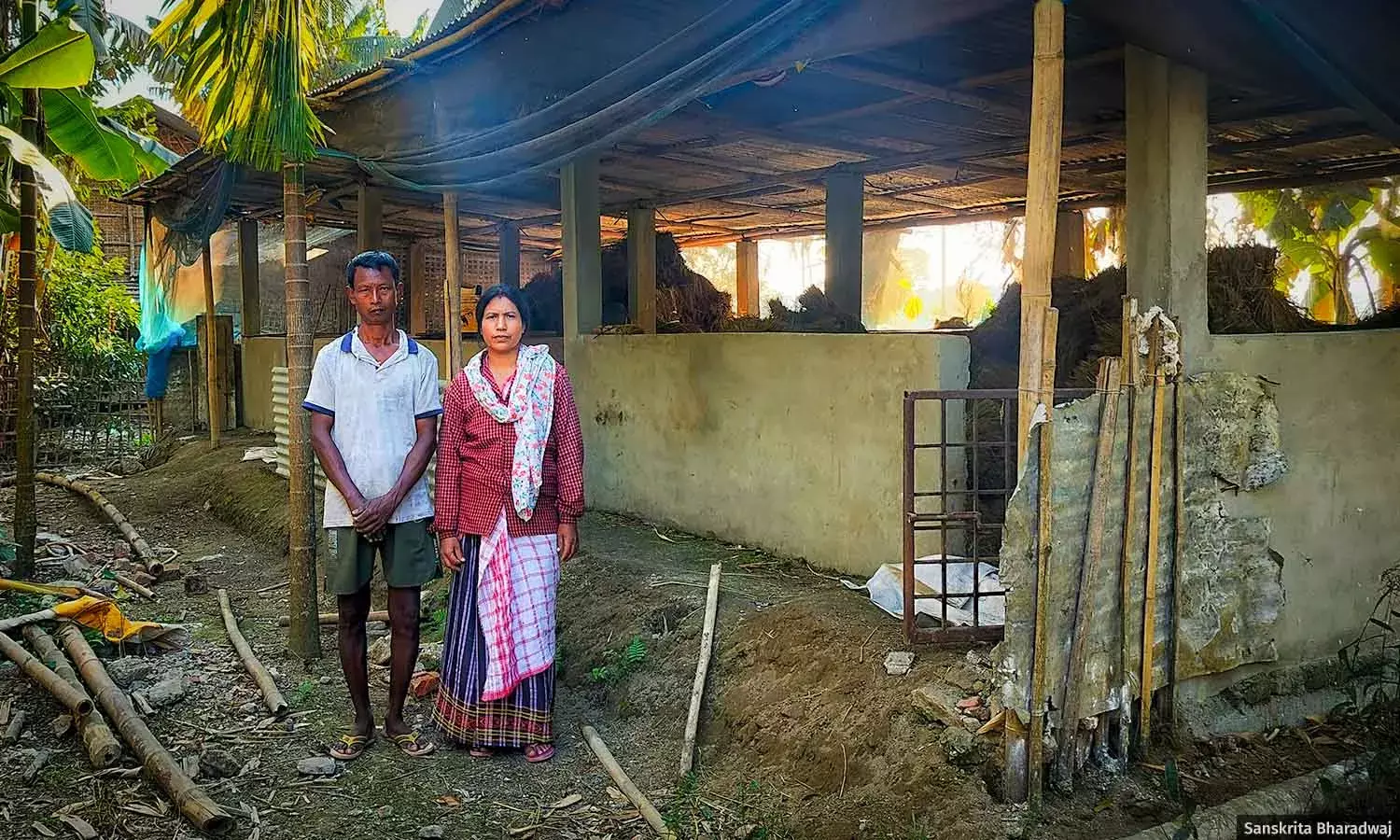
Mridul and Binita Buragohain at their pig farm in Betbari in Sivasagar district of Assam.
Sivasagar, Assam: For 15 years, Binita and Mridul Buragohain built their pig farm in Betbari village, starting with two pigs and slowly expanding to a herd of 75. In October last year, one of their pigs fell ill, and five others died soon after from African Swine Fever (ASF). The rest had to be culled to prevent disease spread.
Pig rearing in and around Betbari—a village of tidy homes among lush green fields, on the outskirts of Sivasagar town in Upper Assam—cuts across communities. Farming and livestock rearing sustain most families in the area. Ahoms, Motoks, Misings, Nepalis, Bodos and Adivasis all depend on pigs as a key source of income.
The Buragohains’ experience reflects the growing toll of ASF across Assam. With no vaccine available and multiple infection pathways, even a single infection can trigger culling drives—erasing years of investment and leaving farmers struggling to recover.
ASF is a highly contagious viral disease. Once infected, pigs do not recover, which is why ASF continues to be a major concern. It was first detected in Kenya in the early 1900s, spread to Europe, China and reached Northeast India in 2020.
“Floating carcasses were first spotted in parts of Dhemaji district in Assam,” Nagendra Nath Barman, head of the department of microbiology, College of Veterinary Science and Animal Husbandry in Guwahati, said. The disease likely entered India through Arunachal Pradesh, he explained.
Since 2022, 64 countries and territories have reported the presence of the virus. In India, starting from Assam, the disease has spread to 22 states. In Europe, Belgium has reportedly managed to eradicate ASF through aggressive biosecurity measures.
Tens of thousands of pigs have died of ASF in Assam and Mizoram alone since 2020. In Assam, major waves hit 2021-2023, subsided somewhat in 2024, then peaked again in 2025 across 30 districts with over 300 epicentres, experts say.
According to Barman, of the 24 known ASF strains globally, a single strain—Genotype 2—has been circulating in Assam. The same strain is prevalent across India and in several Southeast Asian countries, including China and Vietnam.
The virus is highly resilient and primarily affects the circulatory system, said Barman. Infected pigs may release large quantities of the virus through blood, faeces, urine and saliva. Transmission usually occurs when infected animals are moved, or when healthy pigs come into contact with contaminated secretions.
Padum Giri at his pig farm in Betbari in Sivasagar district of Assam.
The culling protocol
Padum Giri from Betbari said 84 of his pigs were culled in October 2025. Pig farming was his primary source of income, supplemented only by a small kirana shop run by his wife, Kalpana Giri.
At its peak, Giri said, the farm generated around Rs 50,000 a month in profit. “The loss has left me with no way out,” Giri, who is also a member of the Pig Farmers’ Association Assam, told IndiaSpend.
Giri said the impact goes beyond individual households. Pig farming grows faster and yields quicker returns than goat rearing, making it central to rural economies in many parts of Assam and Northeast India. “As ASF wipes out herds, village-level financial systems are breaking down, with entire communities losing a key source of sustenance.”
“Livelihoods have been severely affected, particularly among families entirely dependent on pig rearing, leading to a growing social crisis,” said Barman.
Assam has the highest pig population in India at around 2.1 million, about 23% of the 9 million nationally, as per the 2019 Livestock Census. Pigs contribute roughly 5% to total meat output.
For suspected ASF cases, veterinary staff collect blood or tissue samples, which are studied at the regional laboratory in the North Eastern Regional Disease Diagnostic Laboratory in Guwahati, and further at Bhopal’s National Institute of High Security Animal Diseases for final validation. Results are usually available within 36 hours.
Once a case is confirmed, under the National Action Plan for African Swine Fever—issued after the outbreak in 2020—all pigs within 1-km radius of the infected zone are to be culled whether or not they show signs of the disease. Culling is undertaken by state and district veterinary authorities. A further 10-kilometre radius is designated as a surveillance zone.
In Betbari, the disease was first detected on Padum Giri’s farm, and as the Buragohains’ farm fell within the 1-km zone, all their pigs were culled.
“The action plan doesn’t allow us to try and save the remaining pigs,” Giri said. “Even if they are in separate units, all of them have to be culled at once.”
Culling, he added, is expensive, involving heavy machinery and labour. Authorities prefer to complete it in one go rather than returning later. “But for farmers, it’s devastating,” he said.
“It was heartbreaking,” Binita Buragohain said. “Six pigs showed symptoms, but we had to kill all of them. We cried. We couldn’t eat and sleep properly for days.”
The Buragohains earned a monthly profit of up to Rs 30,000-40,000 from piggery. Their farm focused on breeding—keeping pigs for two to three years before sale—though they also reared fattening pigs for eight to nine months to produce meat.
The family also rears cows and cultivates rice and vegetables. But pig farming was their main source of income. The loss has hit the household hard. They have three children—a boy and a girl in school and the eldest daughter in college. “It has been difficult to manage education expenses and even healthcare,” Binita said. Working in the fields, she added, has helped them slowly recover over the past one month.
Slaughter practices, biosecurity and feed concerns
In March 2024, Assam Chief Minister Himanta Biswa Sarma inaugurated a pork processing plant in Nazira of Sivasagar district, reiterating the government’s push to make Assam self-sufficient in pork production and a hub for the Northeast.
The Rs 11-crore slaughterhouse with a capacity of 200-300 pigs a day was built but has never been operationalised, Giri said.
Purnananda Konwar, general manager of the Assam Livestock and Poultry Corporation, said the slaughterhouse has not been operationalised because traders and middlemen are unwilling to use it. “Once operational, inspections, testing and certification would be mandatory, preventing improper handling and the entry of diseased animals into the market,” he added. “At present, middlemen often procure sick animals at low prices from farmers and sell the meat in local markets. In a regulated slaughterhouse, diseased animals would not be permitted to enter the market.”
In a scientific slaughterhouse, pigs are examined before and after slaughter to prevent sick animals from entering the market, blood is properly drained, and meat quality and safety are improved.
Giri said during ASF outbreaks, sick pigs are often bought cheaply, slaughtered, and sold in markets, a practice he believes contributes to the spread of ASF.
In November and December 2025, the Assam government banned inter-district movement of pigs in seven severely affected districts of the state but despite the orders, several sources told IndiaSpend that pork continued to be sold.
Besides, during ASF outbreaks, people stop buying pork out of fear, even though the disease doesn’t affect humans. “Retail prices don’t fall much, but wholesale rates drop sharply, hitting us the hardest,” Giri added.
Human movement is, in fact, one of the biggest transmission pathways, said Barman. “Farmers, handlers, middlemen or traders may carry the virus from one farm to another through clothes, footwear, equipment or vehicles.”
Another risk factor is feeding pigs untreated food waste. Many backyard farmers rely on hotel waste: Commercial feed is expensive (around Rs 20-25 per kg), while food waste costs as little as Rs 5-10. “However, untreated waste can carry ASF as well as other bacteria and viruses,” Barman said. He recommends boiling the waste, cooling it, and only then feeding it to pigs.
According to Jagannath Kalita, Deputy Director (Piggery), Animal Husbandry Department, Assam, biosecurity, not slaughterhouses, is the central challenge. Biosecurity for pigs refers to measures to prevent infectious diseases from entering, spreading within, or leaving a farm, by controlling access, maintaining strict hygiene and disinfecting equipment.
While commercial farms generally follow biosecurity norms, Kalita said that lapses can still occur. “If everyone maintained proper biosecurity, the disease could be controlled,” he said. Assam has nearly 700,000 backyard pig farmers, and many of them allow pigs to roam freely. “Whether biosecurity is maintained in such cases is uncertain,” he added.
But farmers like Binita Buragohain said that they have tried to maintain strict biosecurity by even boiling poultry waste before feeding it to pigs. “We also spray feed bags with disinfectant,” she said.
Rituparna Baruah, a pig farmer from Konwerpur in Sivasagar district, said he suspects commercial feed may have played a role in the spread of ASF on his farm last year, though he stressed that this was based on his own assessment. “I maintain strict biosecurity, so logically the infection should have been lower.”
Thirty-eight pigs on his breeding farm were culled in October. Baruah said he believes the virus did not enter through neighbouring farms or human movement. “There were no pig farms nearby, and whenever I entered the sheds, I followed full sanitisation protocols, including netting and disinfectants,” Baruah said.
Given these measures, Baruah said he suspects the infection may have entered through feed.
Even farms with strict biosecurity can see infections if pigs come into contact with contaminated birds or insects, explained Konwar. Traders often procure diseased animals from farmers and transport pigs from multiple farms in the same vehicle, facilitating transmission, he added. In some cases, infected animals are slaughtered and the meat enters the market, further spreading the infection. He said pork markets are poorly regulated, with slaughter often carried out on the ground without scientific practices or biosecurity measures.
Given the endemic nature of the disease, experts now argue against mass culling and instead advocate “compartmentalisation”—targeted culling of infected animals, strict biosecurity and regular monitoring within affected zones.
“ASF does not spread through air; healthy pigs become infected only through direct contact with contaminated material. Improved sanitation, restricted human access, and segregation of animals are the only sustainable way forward, especially for backyard farms, where biosecurity remains weakest,” Barman said.
Meanwhile, farmers IndiaSpend spoke to are demanding amendments to the action plan, including allowing farms that maintain strict biosecurity to avoid blanket culling unless animals show symptoms.
On culling policy, Kalita said the department has written to the Union government seeking flexibility. “Only the Government of India can amend this protocol—the state government cannot.”
IndiaSpend reached out to the Union animal husbandry department with queries on culling protocols. We will update this story when we receive a response.
Compensation gaps
Farmers whose pigs are culled as part of control measures are compensated based on the animal’s weight: Rs 2,200 for piglets (up to 15 kg), Rs 5,800 for growers (15–40 kg), Rs 8,400 for breeding pigs (40–70 kg), Rs 12,000 for those weighing 70–100 kg and Rs 15,000 for pigs over 100 kg, with funds shared 50:50 between the Union and state governments.
Farmers say the compensation is often delayed, inadequate, and does not take into account the market value. Further, farmers are not compensated for animals that die before culling. As a result, some farmers sell sick pigs instead of reporting outbreaks, undermining disease control, a practice driven by desperation rather than ignorance, they say.
Of the Buragohains’ 75 pigs, six died of ASF and the remaining were culled on October 29, 2025, in line with the National Action Plan. Because compensation is paid only for officially culled animals, the family will not be compensated for those that died.
Though officials completed the paperwork and assured payment, the family has not yet received compensation as of this week, estimated by the state government at around Rs 6 lakh.
The family plans to resume pig farming only if the money comes through. “Our entire capital was invested in the pigs,” said Binita.
Kalita of the animal husbandry department said the scale of the outbreak in 2025 far exceeded official estimates, leading to delays in compensation. “In 2024, we had seven epicentres and spent around Rs 20-25 lakh on compensation. [In 2025], we have recorded about 395 epicentres across Assam, requiring nearly Rs 18 crore,” he said. This has strained funds, he said, delaying payments until the Union government releases its share.
IndiaSpend asked the Union animal husbandry department about the status on disbursal of compensation. We will update this story when we receive a response.
An endemic disease with no vaccine
By December 2025, around 19,000 pigs have been culled in Assam, according to official records accessed by IndiaSpend. But farmers believe the real number of deaths runs into hundreds of thousands, as many carcasses are disposed of privately.
Padum Giri said without scientific slaughterhouses, strict enforcement, faster compensation, and the introduction of a tested vaccine, “2027-28 could see a bigger wave.” Widespread culling leaves very few pigs the following year, Barman explained, and therefore, peak numbers are observed every other year.
ASF is now considered endemic in India. With no vaccine currently approved for widespread use, eradication is no longer considered feasible. Binita Buragohain said, “If a vaccine comes, we will be very relieved. Otherwise, how long can we go on like this?”
“Vietnam, in collaboration with the United States, has developed a vaccine that is already being sold to some countries,” Barman said. “However, it has limitations, it is not recommended for breeding stock and may have side effects.
“It is currently considered suitable only for fattening pigs raised for meat. Indian researchers are also working on vaccine development, though a viable option may still be several years away,” Barman explained.
“Even if a vaccine exists, it cannot be used here directly. It must be validated by the Government of India through trials in Indian conditions,” Kalita said. “If proven effective, the Centre will arrange procurement for states. Otherwise, India is also working on developing its own vaccine, which may take another two years.”
Piggery in crisis – Assam farmers feel ignored by Union govt
Bharat Handique, a pig farmer from Doomdooma in Tinsukia district of Assam and advisor of the Pig Farmers’ Association in the state, said Assam’s only major state-level scheme for pig farmers—the Chief Minister’s Flagship Programme (CMFP) under the State Own Priority Development–General (SOPD-G) scheme—has stalled at the implementation stage.
According to Handique, farmer groups had originally submitted a project proposal worth Rs 456 crore to the state government, following which a scheme of around Rs 441 crore was announced. However, funds were not released on time, he said.
Under the scheme, farmers were required to contribute their own share of capital, with banks releasing loans and the government providing a subsidy component. Two years on, Handique said, many farmers have already invested their own money and taken bank loans, but the government subsidy has not been released.
“As a result, projects remain incomplete, but farmers have already begun repaying bank instalments,” he said. Some farmers, he added, have reported severe financial distress and depression due to mounting debt.
Handique alleged that pig farmers in Assam and the rest of Northeast continue to be neglected in policy planning. “Pig rearing is common in the Northeast, but the government does not take our problems seriously,” he said, adding that pig farmers feel particularly marginalised.
Under the National Livestock Mission—which aims to strengthen livelihoods in the livestock sector, especially for small and marginal farmers—Handique said, 213 applications were forwarded from Assam but only 13 beneficiaries ultimately received loans by 2023-24. These 213 applicants, according to Handique, reportedly spent between Rs 70,000 and Rs 80,000 each—on preparing and submitting applications including traveling to the state capital—only to be rejected.
“This has resulted in heavy losses,” he said. According to him, livestock schemes are often designed with farmers in northern and central India in mind, without accounting for the realities of pig and small-livestock farmers in India’s Northeast.
The Assam government, including Chief Minister Sarma, has publicly spoken about supporting and promoting pig farming through financial assistance and livelihood schemes, even as ASF continues to affect the sector. However, farmers like Giri and Handique say the reality on the ground is stark. “There is talk of revival and self-sufficiency, but local farmers are collapsing,” Handique said.
We welcome feedback. Please write to respond@indiaspend.org. We reserve the right to edit responses for language and grammar.