
Are Indian Schools Accessible To Children With Special Needs?
Half of schools have ramps with handrails, one in three have functional toilets. As a result, enrolment drops at higher grades
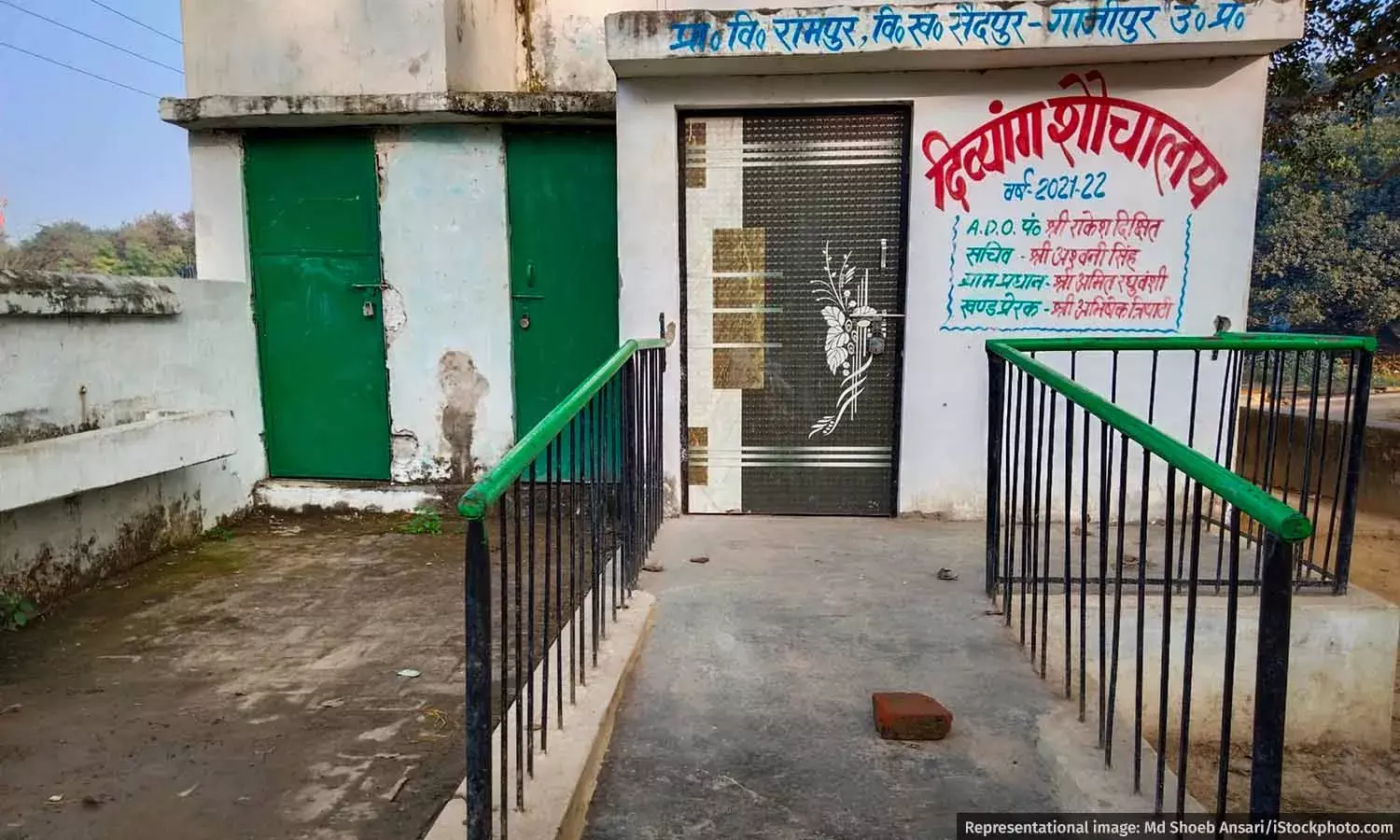
Pune: India has expanded school infrastructure meant to support children with special needs (CWSN) across its nearly 1.5 million schools. By the academic year 2024-25, 79% schools across India had ramps, up from 64% six years earlier. But only 55% had ramps fitted with handrails, a basic safety requirement.
Sanitation access remains more limited. About 36% of schools have CWSN-friendly toilets, and about a third said these were functional, according to data from the Unified District Information System for Education Plus (UDISE+).
These infrastructure gaps coincide with enrollment declines after elementary school, suggesting that accessibility barriers may be contributing to students with disabilities leaving education early.
A 2017 IndiaSpend analysis, based on Census 2011 data, found that 45% of India’s disabled population was illiterate, compared to 26% of the general population, and that among persons with disabilities who were educated, 59% completed Class X, versus 67% of the general population.
The Rights of Persons with Disabilities Act places clear duties on educational institutions to admit children with disabilities without discrimination, make buildings and facilities accessible, and provide reasonable accommodation and necessary support to ensure their full participation in education.
The National Education Policy (NEP) states that ensuring inclusion and equal participation of children with disabilities across early childhood care and education is a high priority, with the aim of enabling their full participation in regular schooling from the foundational stage through higher education.
In five charts, we look at patterns in accessibility and enrolment for children with special needs in India.
4 in 5 schools have ramps, but few have handrails
Nearly four in five schools across India reported that they have ramps, to enable access for children with special needs. But just over half of the schools reported that the ramps were equipped with handrails, an essential feature for safe and independent use by many children with mobility impairments. That is, nearly one in four Indian schools has a ramp which is mostly not usable.
“Most schools are designed with a single idea of ability in mind, rather than being built to accommodate the full range of learners through universal design,” says Deepali Kapoor of the inclusive education team at Pratham, one of India’s largest NGOs focused on improving the quality of education in the country. “This means that children who move differently are treated as outliers rather than as expected users of the space.”
Further, the ramps that are built often lack proper measurements, says Diksha Dinde, a disability rights activist from Pune and founder of the EquiBridge Foundation. “Very few schools follow the gradient guidelines,” she adds, explaining that in many cases, the slope is too steep and “students need external support, which reduces usability and independence”.
“Those who build the ramps often do not know why they are making them or for whom they are making them,” Dinde adds. “There are design flaws such as small steps, uneven surfaces, or the absence of non-slippery tiles.”
A 2023 study found that children with mobility limitations often struggle to move independently within schools, including accessing classrooms on upper floors, playgrounds, toilets, and staff rooms. The study notes that poor physical accessibility can limit participation in school activities and increase dependence on teachers or peers.
In practice, Kapoor says, teachers, helpers, or peers often step in to assist children. “This informal accommodation can inadvertently mask the underlying design problems.”
64% schools do not have CWSN-friendly toilets
In six years to 2024-25, the percentage of schools with CWSN-friendly toilets doubled, but still, only 35.6% of schools reported having accessible toilets, according to UDISE+ data. Fewer still reported that these toilets were functional.
Dinde says that while many schools do have toilets for children with disabilities, they are not well maintained, or ideal setups are not followed. "Accessibility is not just about installing a western toilet or handle bars,” she explains, pointing to factors such as sufficient water supply, cleanliness, step-free access, and whether a child can use the toilet independently that are critical to making them functional.
A guidance note by the United Nations Children’s Fund (UNICEF) highlights that children with disabilities are less likely to benefit from WASH in Schools programmes, as only about 50% of children with disabilities attend school globally. Inaccessible WASH facilities in schools create additional barriers to attendance, particularly for girls with disabilities, who also have to manage menstrual hygiene in inaccessible facilities, something that can undermine dignity, health and school attendance.
Improving this situation requires action at both the school and system levels, beginning with a shift in understanding, Shobhit Kaushik of Pratham’s inclusive education team explains. “Simple, visual guidelines showing correct dimensions, grab-bar height, ramp gradient, and turning radius can help schools translate intent into actual construction,” he adds.
Infrastructure such as ramps, handrails and CWSN-friendly toilets are often treated as an optional or “special needs” upgrade instead of a basic design element that benefits all children (including those with temporary injuries, older adults, pregnant caregivers, and young learners), he adds. If framed this way, schools are more likely to prioritise low-cost retrofits instead of assuming that accessibility always requires major reconstruction.
In practice, Kaushik explains, toilets are sometimes located on upper floors or at a distance from classrooms, effectively excluding children with mobility challenges. Even those that are labeled as functional often lack essential features such as adequate turning space for wheelchairs, properly fixed grab bars (not towel rods), non-slippery flooring, or reliable water supply, making them unsafe or unusable for the very children they are meant to serve.
Kapoor says that local education departments can help by including accessibility compliance as a routine part of school inspections, and providing standard, easy-to-use technical drawings and cost estimates under schemes such as Samagra Shiksha.
Govt schools perform better
In 2024-25, 88% government schools reported having ramps, compared with 60% of private schools, according to UDISE+ data.
Compliance checks, building audits and inspections happen every year in government schools, Dinde explains, but in private schools, “these audits do not happen as regularly, and accessibility is often overlooked”.
Further, dedicated public funding streams and stronger incentives for government schools also account for this gap, Neeraj Trivedi, who heads organisational effectiveness at Pratham, explains. “Private schools, particularly low-fee schools, rarely receive such earmarked public funds and rely largely on fee revenue and management priorities, which can delay accessibility investments even when the intent exists,” he adds.
Enrolment falls after elementary school
Overall, children with special needs form 1% of enrolled students in elementary school (grades I-VIII), 0.9% in secondary (IX-X) and 0.5% in higher secondary (XI-XII) grades—indicating that fewer children with special needs make it to higher grades.
Drop-outs contribute to a decline in enrollment at higher grades. In 2024-25 for instance, 37.2 million students were enrolled in secondary grades, 22% of the 168.1 million enrolled in elementary school. In comparison, enrolment among CWSN students fell 53%.
Similarly, enrolment fell a further 54% by higher secondary grades among children with special needs, more than twice the 26% decline among all students.
This decline coincides with broader challenges within schools. UNESCO’s State of the Education Report for India 2019 notes that teachers often lack training and confidence to teach children with disabilities, work in under-resourced classrooms, and face limited administrative support and large class sizes, all of which hinder inclusive education.
“Children with invisible disabilities require classrooms and teaching-learning processes that allow them to fully engage, regulate, and express themselves,” Trivedi, who also supports government partnerships at Pratham, says. “However, these ideas have only partially entered policy and training discourse, and are rarely tracked or systematically supported in practice.
“As a result, teachers often feel ill-equipped to support diverse learners,” Trivedi explains. “Even sensitive and well-meaning teachers, who genuinely wish to help, may begin to separate children, lower expectations, or recommend special settings simply because they feel they lack the skills and tools to include them meaningfully in regular classrooms.”
During the 2025 winter session, the government told Parliament that Rs 23.42 crore has been approved under Samagra Shiksha for 2025-26 to train over 93,000 teachers in inclusive education through NCERT-NISHTHA programmes.
Dinde stressed the importance of early identification of disabilities. “There are systems in place through anganwadi workers and health workers, but parental awareness plays a crucial role. Often, early signs are denied or overlooked at home. Early identification is critical because it shapes access to timely support, education planning, and inclusion from the earliest stages of life.”
Boys with special needs see a higher decline in enrolment compared to girls, data show.
In addition, Trivedi says, children may be enrolled on paper but attend irregularly, leave early, or eventually drop out. What appears as “low enrollment” in administrative data may often be a series of rational withdrawals by families responding to an environment their child does not benefit from and succeed in.
IndiaSpend reached out to the school education department in the Union education ministry for comment. We will update this story when we receive a response.
We welcome feedback. Please write to respond@indiaspend.org. We reserve the right to edit responses for language and grammar.