
#DataViz: How Women’s Representation Declines From Panchayats To Parliament
Reservation has increased women’s presence in local bodies, but representation remains significantly lower in Parliament and higher offices
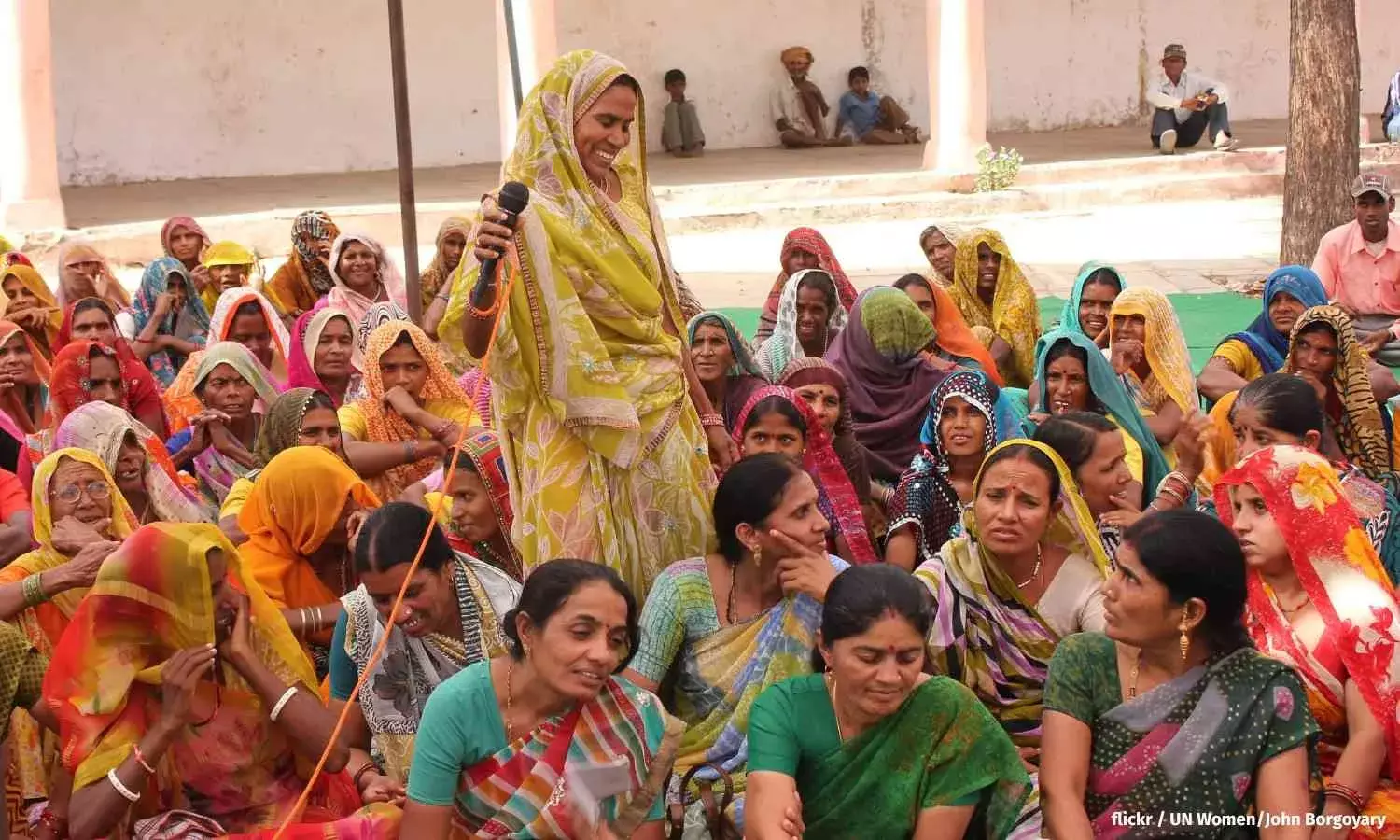
Pune: More than 1.5 million women hold elected positions in Panchayati Raj Institutions across the country. Various states provide for reservation of between one-third and half of all PRI seats for women. In contrast, women account for 13.8% of members in the 18th Lok Sabha, according to data from the Ministry of Statistics and Programme Implementation (MoSPI).
The Constitution (106th Amendment) Act, 2023, provides for 33% reservation for women in the Lok Sabha and state assemblies, but implementation was deferred until after a delimitation exercise scheduled to be conducted after 2026, as IndiaSpend reported in December 2024.
“On the 16th of April, Parliament will be convened to discuss and pass an important bill that advances women’s reservation,” Prime Minister Narendra Modi wrote on April 9, 2026. “It is imperative that the 2029 Lok Sabha elections and the Assembly elections to the various states in the coming times are conducted with women’s reservation in place.”
In five charts, we examine women’s representation and participation across various levels of governance.
Reservation at grassroots
In 1992, India enacted the 73rd Amendment to its Constitution, reserving a third of seats for women in rural and urban local bodies to ensure greater representation for women in general and other excluded groups in particular, such as scheduled castes and scheduled tribes, as IndiaSpend explained in 2017. Some states, such as Bihar, Himachal Pradesh, Andhra Pradesh, Telangana, Tamil Nadu and Gujarat, have extended the reservation of seats for women to 50%.
In 18 states, women now occupy more than half of all PRI seats. Only the Union territories of Dadra and Nagar Haveli and Ladakh have less than 33% representation of women in these grassroots institutions.
A 2026 report on women in local governance found that while reservations expand women's entry into office, their authority does not follow automatically. It noted that authority is shaped by household mediation, bureaucratic discretion, and social norms.
Women in Tamil Nadu’s panchayats have transformed local governance while battling gender prejudice, financial constraints, casteism and physical threat, as IndiaSpend reported in 2018.
There is evidence of significantly higher growth in economic activity in constituencies that elect women, noted a 2018 study by the United Nations University World Institute for Development Economics Research.
It examined data for 4,265 state assembly constituencies—over two decades to 2012—where the “share of state legislative assembly seats won by women increased from about 4.5% to close to 8%” and focussed on the increase of luminosity, or night light, in these constituencies as a proxy for economic activity.
Women legislators in India raised economic performance in their constituencies by about 1.8 percentage points per year more than male legislators, according to the study. “We estimate that women legislators in India raise luminosity growth in their constituencies by about 15 percentage points per annum more than male legislators,” the study noted.
Yet, women account for under one in seven members in the Lok Sabha.
“Reservation has brought women into grassroots politics and created a large number of elected representatives, but has not created pathways to higher levels due to party structures and social barriers,” said Bhim Raskar, director at Resource and Support Centre for Development (RSCD). “In many cases, women who are elected do not function independently. Decisions are often taken or influenced by male family members, so their authority remains limited even though they hold the position,” he added.
A 2024 overview of challenges facing women sarpanches found that many elected women are treated as figureheads, with husbands or other community members often performing panchayat functions on their behalf. The study noted that structural factors such as patriarchy, caste dynamics, social expectations and family influence continue to shape women’s participation even after they are elected.
More women in village councils than parliament
States with higher representation of women in Panchayati Raj Institutions show lower representation at higher levels of government. In Himachal Pradesh, women account for 50.13% of PRI representatives, but only one of 68 members of the state’s legislative assembly (MLAs) is a woman.
Similarly, Karnataka has nearly 53% women in PRIs, but only 4.5% of its MLAs and under 11% of its 28 members of parliament (MPs) are women.
“There is very little vertical mobility for women in politics. Many women enter through reservations at the local level, but very few are able to move ahead to become MLAs or MPs, so most of them remain at the local level,” Raskar said.
The 2026 report on women in local governance found that rotational reservation produces a one-term trap, where women consolidate political experience only to find re-contestation blocked, undermining continuity in office.
In the 32 women-led panchayats IndiaSpend surveyed in 2018 across six districts of Tamil Nadu for a five-part series, 30% women said they would like to contest the upcoming panchayat elections even when their seat was an unreserved one. Also, 15% women said they would like to enter mainstream electoral party politics if given a chance. Across districts, women complained of patriarchal hostility and caste bias.
IndiaSpend reported in 2018 that that legacy played a key role in elections, with many women MLAs coming from political families or networks. It also found that there is no easy correlation between women’s empowerment indicators and female representation.
IndiaSpend reached out to the Ministry of Panchayati Raj seeking responses on the independent functioning of elected women representatives in PRIs and barriers to women contesting a second term. We will update this story when we receive a response.
Women’s representation in the Lok Sabha has increased from 22 of 489 members (5.5%) in 1957, to 75 of 544 members (13.79%) in 2024.
“In many cases, women take a ‘U-turn’ after one term. They enter politics through reservation, but after one term they do not continue because of family responsibilities and lack of support, which makes it difficult for them to continue in politics,” Raskar said.
The Inter-Parliamentary Union’s 2026 data show that women hold 27.5% of parliamentary seats globally, while India ranks 149th.
Under 10% Union ministers are women
Women’s representation in the Council of Ministers increased from 2.6% in 1996 to 17.8% in 2015, before declining to 9.7% in 2024, data for the last three decades show.
“The main constraint is not only political but also social. Family is still the main power structure, and in many cases women are expected to prioritise household responsibilities. Unless that changes, women’s participation will remain limited even if their numbers increase,” Raskar said.
In 2019, IndiaSpend reported that political parties play a key role in determining candidate selection, limiting women’s entry into elections despite their higher success rates. It also noted that the absence of women in party leadership positions reduces the likelihood of more women being nominated.
A 2026 paper on women's political participation found that the odds of success for women candidates with assets below Rs 1 crore are extremely low, and that independent women candidates are almost never elected without party backing. The study identified party ticket allocation as a critical bottleneck, with most parties hesitant to nominate women in winnable constituencies.
Women vote as much as men
Women’s participation in the 2024 general election is comparable to overall turnout at the national level. State-level data show that in several regions, women’s participation exceeds overall turnout.
In several states and Union territories, women’s turnout exceeded 70% but no women were elected. These include Goa, Manipur, Meghalaya, Arunachal Pradesh and Lakshadweep.
Higher turnout among women is linked to factors such as increased literacy, voter enrolment efforts and welfare outreach, an IndiaSpend 2024 analysis found. It also pointed to migration patterns and the expansion of self-help groups as contributing to greater political participation.
We welcome feedback. Please write to respond@indiaspend.org. We reserve the right to edit responses for language and grammar.