
How Araku’s Coffee Farmers Are Tackling Climate Change
Climate is disrupting coffee production and quality the world over, but a model in AP’s Araku is working towards a solution
Lankela Visweswara Rao, 41, is an IT engineer who took to growing coffee in his village, Minumuluru near Paderu, Andhra Pradesh, right out of college. The region has been seeing high temperatures in recent times, Rao says.
G. Madugula, Paderu and Araku, Andhra Pradesh: Coffee farmer Vanthala Raju was 21 when he applied to get his rights over forest land recognised in 2014. It took two years for an official to acknowledge his application, four more for processing. Throughout this period, he faced harassment from authorities.
Changing climate has affected harvests, says Raju, an arts graduate who grows coffee on nine acres. Erratic rains and extreme rainfall events alongside increasing heat have increased work and reduced output and quality.
When it pours, the buds retain moisture and the resultant crop could rot. In cases of extreme rainfall, they just fall to the ground. Heat dries up the buds, and they wilt, turning useless.
Raju is not alone. Climate change is affecting coffee harvests across the world, leading to declining yields and quality, and rising prices.
A new analysis by Climate Central released on February 18 shows that 25 coffee-growing countries—accounting for about 97% of global coffee production—experienced more “coffee-harming heat” during the past five years because of climate change.
On average, India saw 30 additional days of such heat. Kerala saw 65 additional days, the highest increase. Andhra Pradesh (AP) saw fewer additional days (34), but had the highest overall days with temperatures above 30oC at 257.
The area suitable for coffee farming may decrease by 50% by 2050 without adequate adaptation, the analysis says. Arabica coffee plants (which account for about 60-70% of the global supply) are more sensitive to heat than robusta varieties. Even cooler temperatures in the 25-30°C (77-86°F) range are suboptimal for arabica growth.
IndiaSpend has reached out to the chairman and deputy director of research at India’s Coffee Board, and the director of research at the Central Coffee Research Institute in Chikkamagaluru for comment. We will update this story when we receive a response.
India is the sixth largest coffee exporter in the world. Kodagu or Coorg district, located in the Western Ghats in Karnataka, has been facing the impacts of climate change since the last three decades, as IndiaSpend reported in October 2023. The coffee plant has become more susceptible to pests and has witnessed a decline in production, we had reported.
World Bank data suggest that arabica and robusta prices have almost doubled from 2023 to 2025.
IndiaSpend met coffee farmers at varying levels of operations and socioeconomic conditions. While temperatures have impacted yield, those following natural farming practices are seeing better quality and output, and resilience to a pest that was recorded in the valley for the first time in 2025.
Coffee, pepper, and debt
Baram is a small hamlet of about 250 people, 75-km away from Araku—off the highway that connects Rajahmundry and Vizianagaram. Raju is clad in shorts and a polo. His chin is bandaged—he’s had a fracture from a fall in the bathroom.
Raju belongs to the Kodu community, a particularly vulnerable tribal group, and has lived in Baram all his life. He has two children—a son in residential school in grade VI, and a daughter in the primary school about 2 km away.
A three-room house with a low ceiling, his house is sparsely furnished—a single cot, a study table and one LED bulb in the living room, a few utensils and a cookstove in the kitchen. Adjacent to these is a storeroom, holding supplies, and produce yet unsold—he showed a bag of fresh pepper pods.
His wife applied to be a teacher, but did not get selected. Today, she is helping a neighbour pour concrete for a slab—an activity which draws help from many in the community.
Settling into a plastic chair in front of his house, the scent of drying turmeric wafting across the narrow lane between the row of houses and the forest, Raju narrates his experience with coffee.
Forty-three-year-old Vanthala Raju grows coffee on nine acres in Baram, under G. Madugula mandal of Alluri Sitharamaraju district.
This last harvest, Raju sold about three tonnes of coffee cherries to Naandi Foundation, two more tonnes to the AP Girijan Cooperative Corporation (GCC) and some rejected stock in the open market. Growing coffee is labour-intensive, and the community works on each other’s farms to reduce labour costs.
Apart from coffee, Raju also grows pepper, the vines of which climb up the shade trees. On his ancestral land, he grows turmeric, ginger, some vegetables and subsistence paddy.
He estimates that he made about Rs 3 lakh in this crop over four years. His family has incurred a debt of about Rs 3 lakh on children’s education and construction expenses.
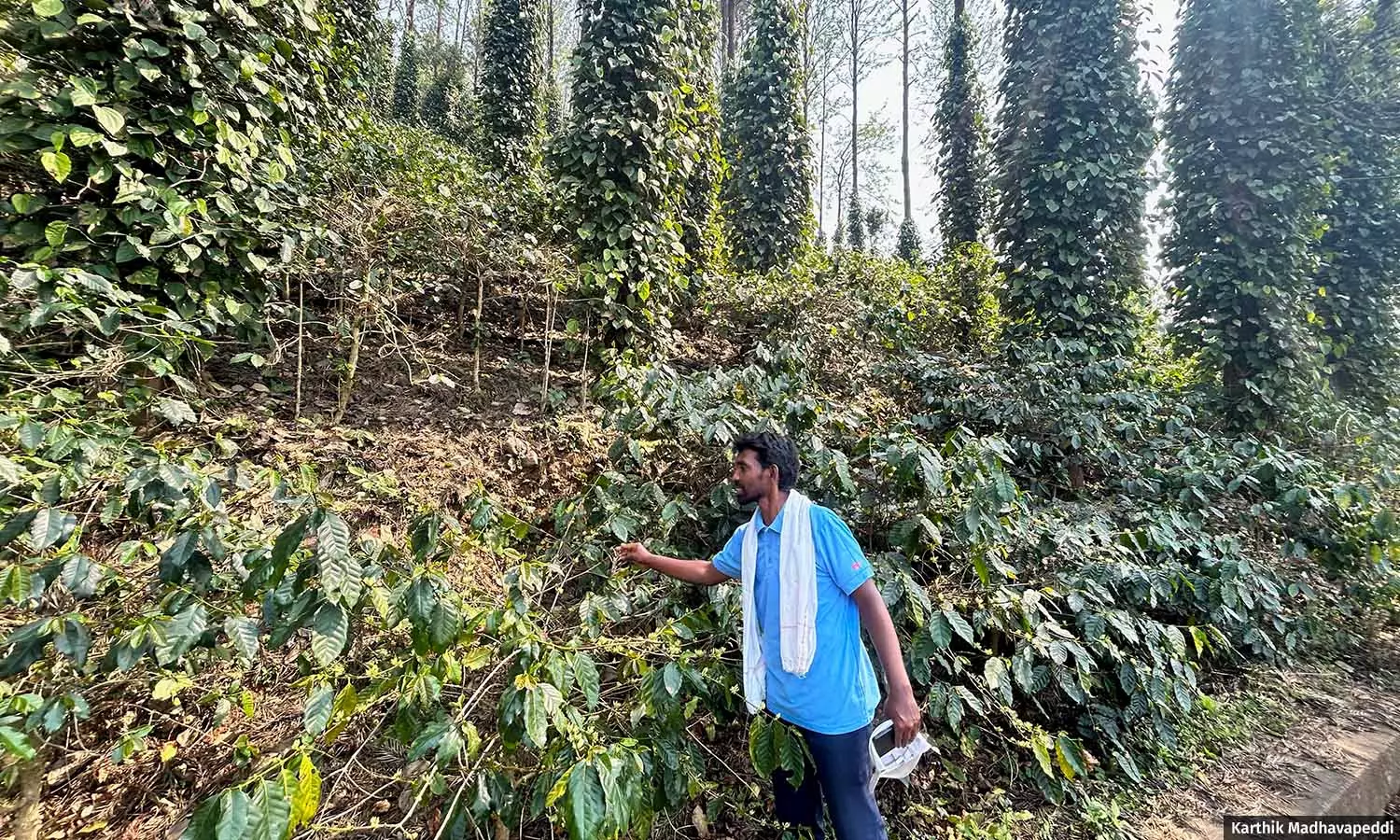
On his plantation, Raju demonstrates how mulching is done to protect the moisture in the roots, how stems that have wilted or have not borne flowers are to be broken off, lest they consume the nutrients that the productive parts need. And how to identify flowers that will go on to the next stage and those that will wilt.
Unlike in most of the world where coffee is grown under the sun, in these parts, coffee is shade-grown. Primarily, the government distributed silver oak saplings because they grow fast and have a hard bark, on which pepper vines can climb.
Raju’s village eschewed silver oak. The elders believed that the species attracts more thunder and lightning. So they grow coffee under the share of natural forests and fruit trees.
Vanthala Raju demonstrates how stems that have wilted or have not borne flowers are to be broken off, lest they consume the nutrients that the productive parts need.
Now, the government is looking to add five types of trees to improve diversity, offer additional sources of income for the tribals, and keep them occupied on the farm throughout the year, so they also care for the coffee plants diligently.
Several organisations are involved in supporting Araku’s coffee growers, such as Walmart Foundation, Smart AP Foundation and Ayekart. Naandi Foundation has enlisted European companies to provide 17 varieties of trees, including fruit-bearing and timber trees, in exchange for carbon credits. The farmers sell fruit such as guava, lemon, and other citrus fruits in local markets. This has ensured they earn an income throughout the year.
Raju prides on the fact that they use completely organic methods and has not seen any pest in his farm or those of his neighbours.
The 20-year arc
Manoj Kumar is the founding chief executive officer of Naandi Foundation. He is leading projects in Andhra Pradesh, Maharashtra, Punjab and Uttar Pradesh spanning the areas of healthcare, maternal mortality, child development and regenerative agriculture. The last of them is a technique perfected in the Araku region, on which Kumar spent 20 years helping small-holder farmers grow coffee.
The district has a population of about one million, 83% belonging to Scheduled Tribes. Coffee was introduced by the British in the late 19th century and subsequently spread to the Araku valley. In the 1980s, the government handed over plantations to the tribals—at two acres per family—mainly to check rampant deforestation under podu cultivation, a slash and burn method of farming.
In the face of multiple challenges, Kumar realised that the tribal communities needed a sustainable livelihood from the forests. “On a whim and a fancy and ignorance, when some farmers asked me if they can grow coffee, I said yes, without knowing how to grow coffee,” he says.
Back in 2004, Naandi Foundation started their work around coffee with 1,000 farmers in about 800 acres. Today, they work through the Small and Marginal Tribal Farmer Mutually Aided Cooperative Society (SAMTFMACS) with about 100,000 farmers across roughly 100,000 acres, about 38% of the 260,000 acres estimated to be under coffee cultivation in the region. They have spent about Rs 300 crore in the last 25 years on their initiatives in the region, Kumar says.
The transformation of Gondivalasa village between November 2011 and October 2022. Credit: Naandi Foundation
Back in 2005-06, the coffee cherry used to be sold for as little as Rs 2 a kilogram, mostly to moneylenders, he explains. For context, 6 kg of cherries make 1 kg of clean coffee or parchment, which is then roasted, ground and sold. (See image below.) The best the farmers could make was Rs 20 per kg.
“Naandi bought cherries at Rs 30 per kg [which is Rs 180 per kg of parchment],” Kumar says. At the time, procurement in the Western Ghats was done at around Rs 90 per kg of parchment. Having bought at these rates and incurring additional costs, “I couldn't frankly sell it at Rs 180,” Kumar says.
Coffee at different levels of processing. Top (left to right): Cherry, parchment, pulped and sun dried, and honey-processed. Bottom (left to right): Cleaned versions of cherry, parchment, pulped and sun dried. Six kg cherry makes one kg parchment.
So they did two things: scaled up production by roping in more farmers, and set up a central processing unit. They registered a company called Araku Originals Private Limited, mandated to procure and sell the produce. In 2015, they entered retail sales, started selling online, B2B and set up cafès in Paris, Mumbai and Bengaluru. This company is still not profitable, Kumar says.
This last year, Naandi procured coffee at an effective price of Rs 420-Rs 840 per kg of parchment, compared to the GCC’s Rs 270, and the Rs 200 in the open market.
The biology of resilience
Vinod Hegde, head of quality production warehousing, started his work with coffee about 20 years ago in Kodaikanal, where he met David Hogg, the regenerative agriculture specialist who spent 55 of his 75 years in India. In 2011, Hegde moved to Araku, following Hogg.
The processing unit is currently idle, as the processing for the latest harvest is complete. The coffee is stored in their godown, in stacks of 40-kg bags.
The coffee processing unit at work in Araku. Credit: Naandi Foundation
At the beginning of the season in October, Hegde says, Naandi conducts an annual general meeting and announces the procurement prices. If market prices rise, they pay a bonus, but if the market falls, farmers still receive what was announced in that meeting.
Procurement is done at the villages, and different grades of coffee are put together in batches for processing. The grades are determined based on terroir mapping, a process similar to the landscape study conducted by wineries.
Vinod Hedge, head of quality production warehousing at Naandi foundation explains the rates at which they procure different grades of coffee.
Several steps in the processing are attuned to preserving quality, Hegde explains. For instance, drying is done on racks that do not touch the ground—lest the soil’s aroma enters the coffee. Women turn the beans multiple times to ensure they are sun-dried—something that can be achieved through industrial fans. A majority of the employment is given to women during the processing, Hegde explains. “And we pay men and women the same.”
Hogg, Hegde and their team formulated probiotics and inoculants from the soil and plants—which helped fix micronutrients. They developed what Kumar calls an “army” of over 4,000 farmer trainers who helped take the techniques to the larger region.
Women turn the beans multiple times to ensure they are sun-dried.
Buridi Sundaramma of Gondivalasa village in Araku grows coffee on three acres. “Naandi taught us how to plant the saplings, how to prune and remove dried stems, mulching, etc.”
“When planting, we separate the top and lower soil strata, dig 2 feet wide and 2 feet deep pits, add top soil layer with compost and plant the sapling,” Sundaramma, who belongs to the Kodu community, explains.
“This process resulted in this region having no pest attack of any kind till date for these 100,000 farmers,” Kumar says. Studies have shown that even in adjacent plots, yield drops from pest attacks are lower where climate-resilient practices are being employed, explained Sri Pooja Tirumani, a civil servant who heads operations at the Integrated Tribal Development Agency (ITDA), Paderu.
These methods have ensured that there is a five-degree difference in temperature between the coffee estates and the peripheries, Kumar says. The only thing they are unable to control for is the erratic rains—delayed or unseasonal rain, both of which affect yield.
Abutting the five-acre processing unit is what locals called wasteland. But using these very techniques, the team grew a patch of vegetables.
Buridi Sundaramma on her coffee plantation in Araku’s Gondivalasa. In the background are rows of coffee plants, growing under the mixed shade of silver oak and fruit-bearing trees.
The pest
“In the Agency area, so far, we have not seen a large-scale yield drop, but it is a mix of factors,” explains Tirumani. Project officer is a catch-all designation for monitoring health, education, constitutional safeguards and protections, planning and implementation, and a range of administrative duties in the region. ITDAs were created in the 1970s and 1980s as additional institutions for delivery of public goods and services to Scheduled Tribes.
“Kerala and Karnataka see yield drops because productivity has already peaked there but here, coffee cultivation is mostly ‘uncared for’,” she explains. “The tribals [here] are not very invested in making it a high-yielding crop. It is mostly a sustenance mode of farming.”
But climate change has led to an increase in incidence of pests, she explains. While the coffee berry borer has been a prominent pest in the Niligris and other coffee plantations in the last 20-30 years, Araku and Koraput areas had never seen this, she adds.
“And 2025 is the first year where we've been affected with coffee berry borer.” Other borers like the white stem borer, which were prevalent in small numbers, are also seeing an increase. “The reproduction rate and fertility of these pests increases in warmer and humid conditions,” she explains.
The coffee berry borer was suspected to have entered Araku because of movement of plant material by Naandi Foundation. Hegde said they do not re-use jute bags. Each bag in their warehouse is tagged with a QR code that enables them, he says, to track as far back as individual farmers. And they have submitted this evidence to the district authorities.
The income gap
Sundaramma has been growing coffee for about 25 years now. On her three acres in Gondivalasa, she got 1,600 kg of cherry this harvest, which converts to about 530 kg of parchment. She sold some in the open market at Rs 270 per kg, while to Naandi, she sold cherries at Rs 70 per kg, which gives her an effective price of Rs 420 per kg of parchment.
They also have fruit trees such as lemon, jamun, guava, custard apple, and ramphal (red custard apple), etc. In all, she made Rs 1.7 lakh from coffee. She estimates that they spent about Rs 30,000 on labour.
“The remaining money we end up spending in one day—on children’s fees, on the health of cattle, etc.,” she says. The family has a debt of Rs 1 lakh, taken for children’s education. “The debt has been increasing,” she explains.
“Naandi taught us how to plant the saplings, how to prune and remove dried stems, mulching, etc.,” Sundaramma, a mother of three, says. “Earlier, we were not pruning, mulching etc. and we used to get small yields, but now we are getting better yields.
Sundaramma’s elder son is preparing for entrance exams for banking sector jobs, a daughter is preparing for teacher recruitment, and another son is pursuing his bachelor’s degree. Sundaramma and her husband are both illiterate, and were engaged in podu cultivation earlier.
“It would help if the government helps us with farming implements and shade trees,” Sundaramma says.
Buridi Samba is 35 and grows coffee on just under an acre of land. Last year, he earned about Rs 1 lakh, including about Rs 15,000 just from lemon.
“Over 72,000 people make a net profit of over Rs 1 lakh [annually], even from the tiniest portion of land,” Kumar says. “Now, in many families, the father and son have separate plots. And so we have double lakhpatis.”
As of 2022-23, the Paderu Agency area had about 218,000 coffee farmers cultivating about 227,000 acres, the Girijan Cooperative Corporation (GCC) data show. Put together, they grew about 71,000 tonnes of fruit that year—that is, on average, 313 kg per acre. Of this, about 3,500 tonnes (5%) had been procured from 2,200 farmers (1%). Procurement is yet to reach pre-pandemic levels, data show.
Naandi procured 2,000 tonnes of fruit of the highest quality, Kumar says. “We've been increasing the price every single year. Only then will I get that quality.”
IndiaSpend reached out to the GCC and the district collector for latest data on procurement and number of farmers. We will update this story when we receive a response.
The divide
While people are indeed earning, which is a leg up from subsistence slash and burn farming, governments need to create markets and make the tribals custodians of the value chain, says Ramarao Dora, convenor of the Adivasi Joint Action Committee.
Dora is a tribal leader and former visual journalist. His living room is filled with memorabilia. In a room that doubles up as a study, there is a desktop computer and a printer, where he is working on pamphlets for a yatra to be undertaken later in the week. There is a large speaker, the kind you see at parties, for the protests and the meets that are routine for a leader.
“Why is the ITDA or GCC not able to create the market that became possible for a Naandi Foundation? Authorities are not taking an interest, and do not want to create a sustainable market here primarily,” he says.
Governments should create farmer organisations/societies, get them to procure, establish processing units in the region and create market systems, says Ramarao Dora, convenor of the Adivasi Joint Action Committee.
“We request the government to not see adivasis as growers of coffee and pepper,” Dora says. “When we do not create the right market here, in future, there will be a monopoly or syndicates—buying whatever quantity or price they dictate.”
More people are now growing coffee and pepper in the region. “If all farmers move to coffee and pepper, in the absence of a market, the system will crash,” he explains, citing the example of farmers across the country discarding tomatoes when prices crash.
They have had this experience with turmeric and other forest produce, for which the market has disappeared. “People came from outside and made profits, but tribals do not know what is the market for it. Now, the GCC is not buying any forest produce,” he adds.
Coffee grown in these areas is of much better quality and tastes better, he says, adding that governments should create farmer organisations/societies, get them to procure, establish processing units in the region and create market systems. ITDA or similar organisations should not remain as mediators, he cautions.
Missing value addition
Lankela Visweswara Rao is 41, an IT engineer by education, having graduated just before the global financial crisis. He could have found a relatively high-paying job and led a cushy life, but chose to come back to his village and take over his father’s coffee plantations, he says. This was 20 years ago.
Rao belongs to the Bhagata community. His mother Chittamma is the sarpanch in Paderu’s Minumuluru. Today, she is handling the harvest and sale of pepper. His wife has a PhD in botany and horticulture, and teaches at the degree college in Paderu. Does she give him suggestions and tips? Rao is quick to smile. She is more academic, he explains.
Today, Rao holds eight acres, four of which he added this year. In the last harvest, he was able to make 3,600 kg of cherry, or 600 kg parchment. He is vice chairman of a farmer-producer organisation—Paderu Farmer Producer Company Limited—with 370 members. The collective markets and sells coffee and pepper together.
“We never saw temperatures over 24oC degrees, now we are seeing more than 30oC,” says Rao, seated in the sarpanch’s residence. Inside the office room, there’s the familiar smell of turmeric.
Rows of coffee plants under the mixed shade of silver oak and fruit-bearing trees, with pepper vines climbing up the barks, in Gondivalasa village near Araku, Andhra Pradesh.
“Rates have been better since the past year—about Rs 400 per kg,” he says. “Earlier, we used to get, for instance, about Rs 200 per kg during Covid.” Rao earned Rs 2.5 lakh from coffee harvests, but says that his expenditure on labour has increased. They get the crop processed privately at a cost.
“In Kerala or Karnataka, where we are taken for study tours by the Coffee Board, we see that farmers there do packing, labelling and sell coffee on their own plantations,” he says. In Rao’s office are unbranded packets of turmeric and filter coffee.
“Processing units are being set up in non-tribal areas such as near Narsipatnam,” Rao says. “The government should help us market better and create value addition,” he says.
“Usually, coffee undergoes two levels of processing,” explains Tirumani, the project officer at ITDA. “The first level where it turns into parchment is very good to do at this altitude. But when hulling is done and when it is cured and roasted, it is better to be at a lower altitude. That's why it is being put up in Narsipatnam.” The government will set up two more processing units for primary processing in the region, which will be run by tribal societies, with ITDA overseeing finances, Tirumani says.
Rao’s plantation is accessible through the entrance of the Minumuluru waterfall, and he leads the way adjoining paddy fields, on the concrete enclosure of a nala. A woman is washing clothes on the way, and Rao, the sarpanch’s son, is concerned that errant tourists who seek quiet spaces in the forests for revelry will cause her nuisance. He advises her to go home soon.
The plantation is different from Raju’s in one key detail: the silver oak trees. The trouble with silver oak is that its leaves do not decompose well. So, it is practically unusable for mulching.
“This time of the year, all the leaves fall, and shade is lost. In the natural forest, there is cover 365 days a year,” he says. So, why are they sticking to silver oak? “We don’t have the heart to chop them,” he smiles.
Scaling up
The extent of land under coffee cultivation is unclear. “Currently, it is 260,000 acres, of which about 210,000 acres are active. 50,000 acres are dormant or they're not being cared for,” Tirumani says, adding that some land is not captured in the statistics because people do not report cultivation, fearing backlash.
“We are planning to take up a complete mapping through GCC and AP forest development corporation and ITDA. And we are expecting that maybe by next year's season, we'll have a complete account,” she explains.
The yield is about 300 to 500 kg per acre—about a third of the 1,500 kg in the Western Ghats, Tirumani says. And the extent of land is also smaller.
“ITDA Paderu area has been doing coffee expansion. We're going for 100,000 additional acres. And we're also doing rejuvenation—we are putting more coffee plantations in 75,000 acres. We are trying to make it more climate-resilient,” she adds.
Araku holds the potential to triple yields in three-four years, Tirumani says. “Our primary focus is on the upcoming 100,000 acres being developed from scratch. This will be developed in the most scientific manner and productivity can be enhanced immediately.”
Increasing yield will also depend on the farmer going to the fields regularly. That is also a reason for encouraging mixed shared plantation, she says, so that “throughout the year they have some or other reason to go to the field so that they can cater to the needs of the coffee also”.
Secondly, they are trying to streamline procurement. She points to instances of cheating such through manipulating the scales or weighing machines, or predatory lending practices.
Starting this year, the administration has registered all traders—and this registration will be mandatory for transporting produce from next year, she explains. About 80% of traders have already registered. This allows for close monitoring to avoid cheating, and helps traceability to avoid pest entry, she explained.
In addition, the government is going to build a 200-acre coffee park for experiential tourism, for which a request for proposals has been floated. “Tourists can get an entire plantation tour, and can experience cupping, roasting—giving them a holistic coffee experience,” she explains.
“Araku does not have the early mover’s advantage, but can capture specialty coffee,” she adds.
The replication question
Can Naandi Foundation’s model of farming be replicated? Delegations from Kerala and Odisha have visited about five years ago, but they end up replicating the processing, Kumar says. “The magic is not in my central processing unit or my roasting and packaging; it is what the farmer does with the farm.”
Kumar says Naandi Foundation is willing to share the recipes and probiotics for replication. They cost about Rs 2,000-3,000 per acre, about a tenth of the cost of chemical fertilisers and pesticides, he adds.
“That's what farmers of Araku can offer to the rest of the world—a combination of biodiversity, mulching, preserving soil moisture, which can, using life science and biology, thwart the effects of climate change. “But I want to tell you there is no shortcut. It's tremendous hard work.”
Naandi Foundation is using the same agricultural practices working with farmers to grow mango in Uttar Pradesh’s Shravasti, Kumar says. Shravasti is among India’s poorest districts, as we reported earlier. They are also working in three districts in Punjab and one in Maharashtra.
In Kerala’s Wayanad, the government is developing a carbon-neutral coffee park to ensure best practices in the natural utilisation of the soil strata and measures aimed at carbon neutrality are made, says A.P.M. Mohammed Hanish, principal secretary for industries and education in Kerala and the state’s representative on the Coffee Board.
The park also focuses on remunerative prices for farmers. With the support of academics from Europe, the government has been studying and helping farmers with climate-resilience, he adds.
Back in Gondivalasa, Hegde bought some lemon from Sundaramma’s plantation. A few hours earlier, at lunch, the restaurant 20 minutes away did not have lemons and was using essence, just as the state’s tourism department hotel served coffee from outside the valley—an indication of the distance yet to be scaled.
We welcome feedback. Please write to respond@indiaspend.org. We reserve the right to edit responses for language and grammar.